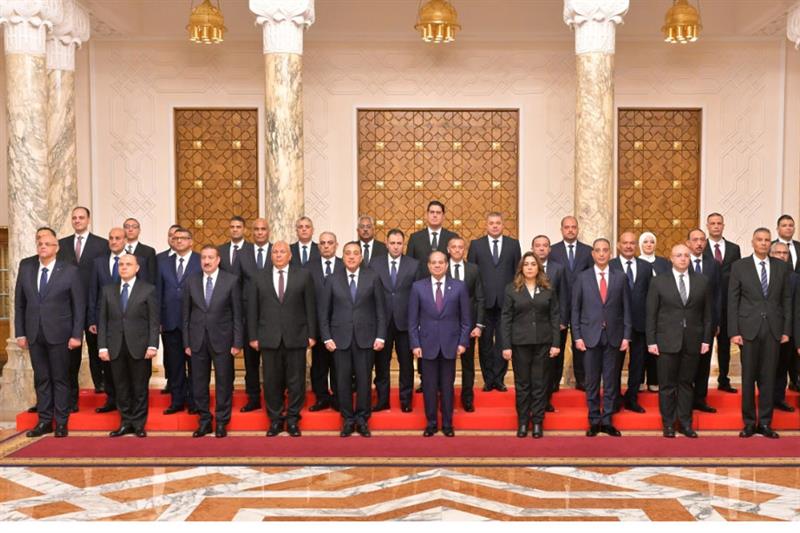

On Monday, February 16, 2026, President Abdel Fattah El-Sisi witnessed the constitutional oath ceremony of Egypt’s newly appointed governors and deputy governors at the Presidential Palace in Heliopolis, Cairo. The ceremony was attended by Prime Minister Mostafa Madbouly and Minister of Local Development and Environment Manal Awad.
The move marks a significant step in Egypt’s ongoing efforts to reform and modernize local administration, enhance public services, and accelerate development projects across the country’s governorates.

A Fresh Push for Local Government Reform in Egypt
The swearing-in ceremony reflects the state’s broader strategy to improve the efficiency of local governance by introducing new leadership and strengthening executive performance at the governorate level.
Following the oath-taking, the newly appointed governors and their deputies posed for an official photograph with the president before attending an expanded meeting to discuss national and local priorities for the upcoming phase.
This reshuffle is widely seen as part of Egypt’s administrative reform agenda, aimed at empowering local leaders to respond more effectively to citizens’ needs and ensure faster implementation of development initiatives.
Notably, the list included Hanan Magdy Nour El-Din Mohamed as Governor of New Valley, alongside Dr. Amira Yassin Mohamed Heikal as Deputy Governor of Alexandria, reflecting growing confidence in the competence of Egyptian women and their ability to manage executive portfolios with efficiency and professionalism.
Clear Presidential Directives for Governors
During the meeting, President El-Sisi emphasized the pivotal role governors play in managing local affairs. He stressed the importance of dedication, integrity, and hands-on leadership, urging officials to move beyond formalities and focus on delivering tangible results.
The president underlined that a governor’s success directly impacts overall state performance, making accountability and performance measurement central to the new phase.
Among the key directives highlighted:
- Maintaining continuous communication with citizens and addressing complaints seriously.
- Ensuring the efficient management of public resources and equipment.
- Strengthening cooperation with investors and the private sector to boost local economic development.
- Upholding transparency and maintaining close coordination with the central government and Parliament.
Prioritizing Public Services and National Projects
President El-Sisi also stressed the importance of closely monitoring essential service sectors, including legalizing building violations, upgrading drinking water and wastewater treatment stations, and ensuring the smooth operation of schools and educational institutions.
A major focus was placed on completing projects under the presidential “Hayah Karima” (Decent Life) initiative, one of Egypt’s flagship rural development programs designed to improve infrastructure and living standards in underserved communities.
He further called for direct oversight of sanitation campaigns, bakery operations, and field visits to resolve citizens’ daily concerns, in addition to firmly confronting illegal encroachments on agricultural land and waterways, enhancing urban planning standards, and preserving the visual identity of each governorate.
Supporting Tourism and Sustainable Development
In governorates with strong tourism potential, the president emphasized the need to remove obstacles facing investors and accelerate tourism-related projects. Strengthening tourism competitiveness remains a key pillar of Egypt’s economic growth strategy, helping generate foreign currency revenues and create new job opportunities.
Overall, the swearing-in of new governors and deputy governors underscores Egypt’s commitment to improving local government performance and ensuring that development plans are effectively executed on the ground, reinforcing administrative reform and sustainable development across all governorates.