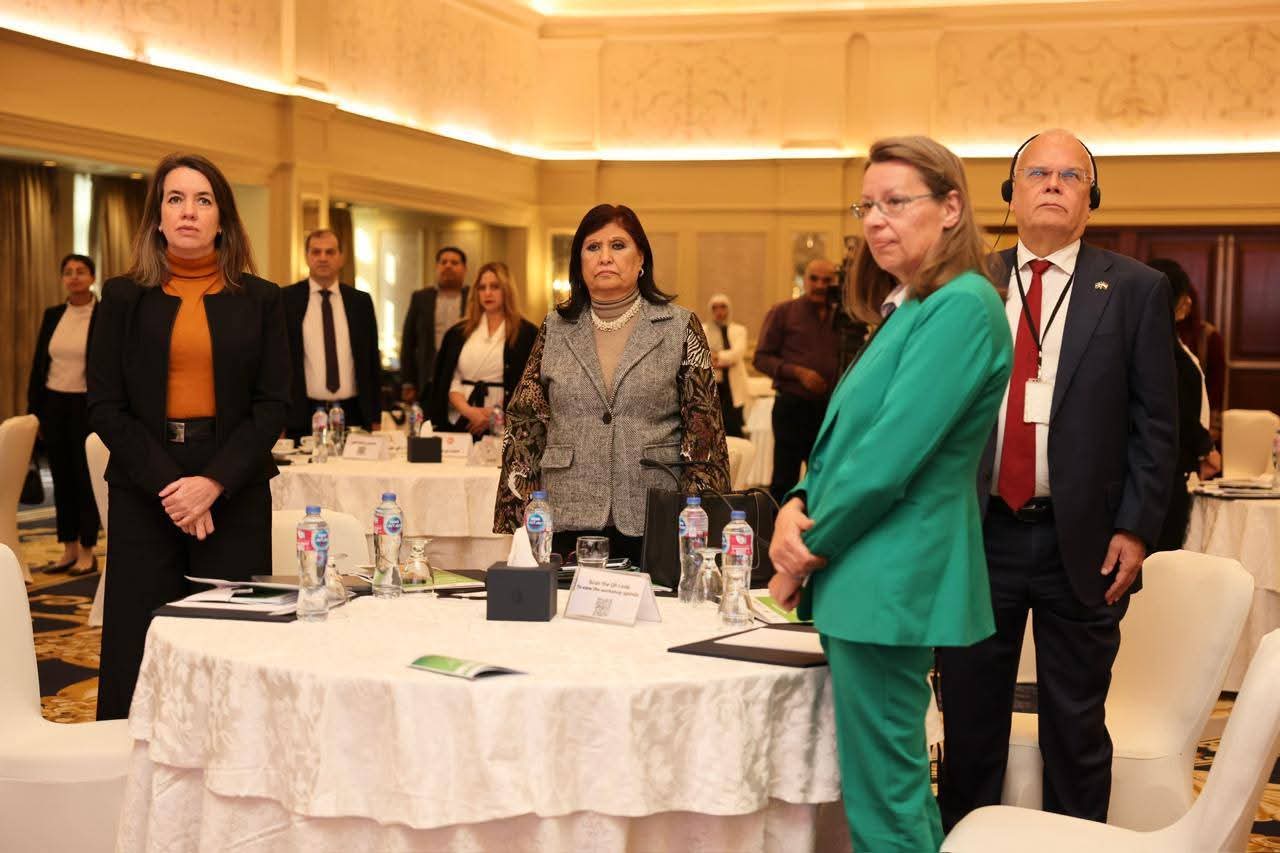

The National Council for Women (NCW) participated today in a regional workshop on “Paid Leave and Flexible Work Arrangements: Promoting Family Wellbeing and Gender Equality”, aimed at developing a regional roadmap for the care economy in the Arab region. The workshop was organized by the Arab Women Organization in partnership with the NCW and UN Women, as part of a series of regional workshops designed to advance policies supporting women and families.
Key Participants
The workshop received high- profile attendance, including :

- Dr. Nesreen El-Baghdadi, Vice President of the NCW
- Janika Köckler, Deputy Regional Director for Arab States, UN Women
- Dag Juhlin-Danfelt, Ambassador of Sweden to Egypt
- Anette Funk, Head of the WoMENA Program, GIZ
- Dr. Fadia Kiwan, Director General of the Arab Women Organization (via recorded message)
Women’s Role in the Care Economy
Speaking on behalf of NCW Chairperson Amal Ammar, Dr. Nesreen El-Baghdadi emphasized that the workshop addresses not just a social issue, but a critical development agenda that directly affects economic growth and sustainable development. She highlighted that international experience shows that investment in the care economy—covering childcare, elderly care, parental leave policies, and flexible work arrangements—boosts productivity, reduces gender gaps in the labor market, and enhances family wellbeing.
Dr. El-Baghdadi noted that, despite progress in the Arab region, women still face significant barriers to full economic participation. Challenges include limited paid leave, insufficient flexible work options, and disproportionately high unpaid care responsibilities—sometimes three times greater than those of men. The workshop aims to provide a platform for dialogue, knowledge exchange, and best practices to develop a shared Arab vision supporting comprehensive policies that address women’s and families’ needs.
National Efforts in Egypt
Dr. El-Baghdadi acknowledged the support of President Abdel Fattah El-Sisi, noting Egypt’s ongoing commitment to women’s empowerment, particularly in economic participation. The 2020 Constitution (Article 11) guarantees gender equality across civil, political, economic, social, and cultural rights and ensures that women can balance family and work responsibilities.
Egypt’s National Strategy for Women’s Empowerment 2030 aims to expand women’s access to employment, enhance entrepreneurship, increase workforce participation, and ensure women’s share of projects and funding. Recent legislative reforms, including the new labor law, protect women from discrimination, secure parental leave rights, and support flexible working arrangements during pregnancy and childcare periods.
Additionally, the Ministry of Social Solidarity recently completed a national census of childcare centers to improve early childhood development services, underscoring the strategic importance of investing in young children for Egypt’s future.
NCW’s Strategic Role
The NCW plays a central role in advancing policies for paid leave and flexible work by:
- Submitting legislative proposals
- Conducting research on the care economy and its impact on women’s economic empowerment
- Promoting institutional practices that support families in public and private sectors
- Strengthening regional and international partnerships to exchange knowledge and best practices
- Raising public awareness on equitable distribution of care responsibilities within households
The council has also collaborated with the World Bank on studies and programs related to women’s economic empowerment, labor market participation, and supportive legislation. Through the Egyptian Women Observatory, the NCW produces policy papers based on accurate data and evidence-based indicators.
Dr. El-Baghdadi stressed that the workshop coincides with the 16 Days of Activism Against Gender-Based Violence, highlighting that inadequate care policies can indirectly perpetuate inequality and affect women’s physical and mental health. She emphasized that the development of a regional roadmap for the care economy is a shared commitment toward a more prosperous and just future, ensuring women’s equitable participation, family wellbeing, and societal cohesion.
In closing, Dr. El-Baghdadi thanked the Arab Women Organization, international partners, and experts for their contributions, reaffirming the NCW’s commitment to transforming the workshop outcomes into actionable policies supporting women and families across the Arab region.