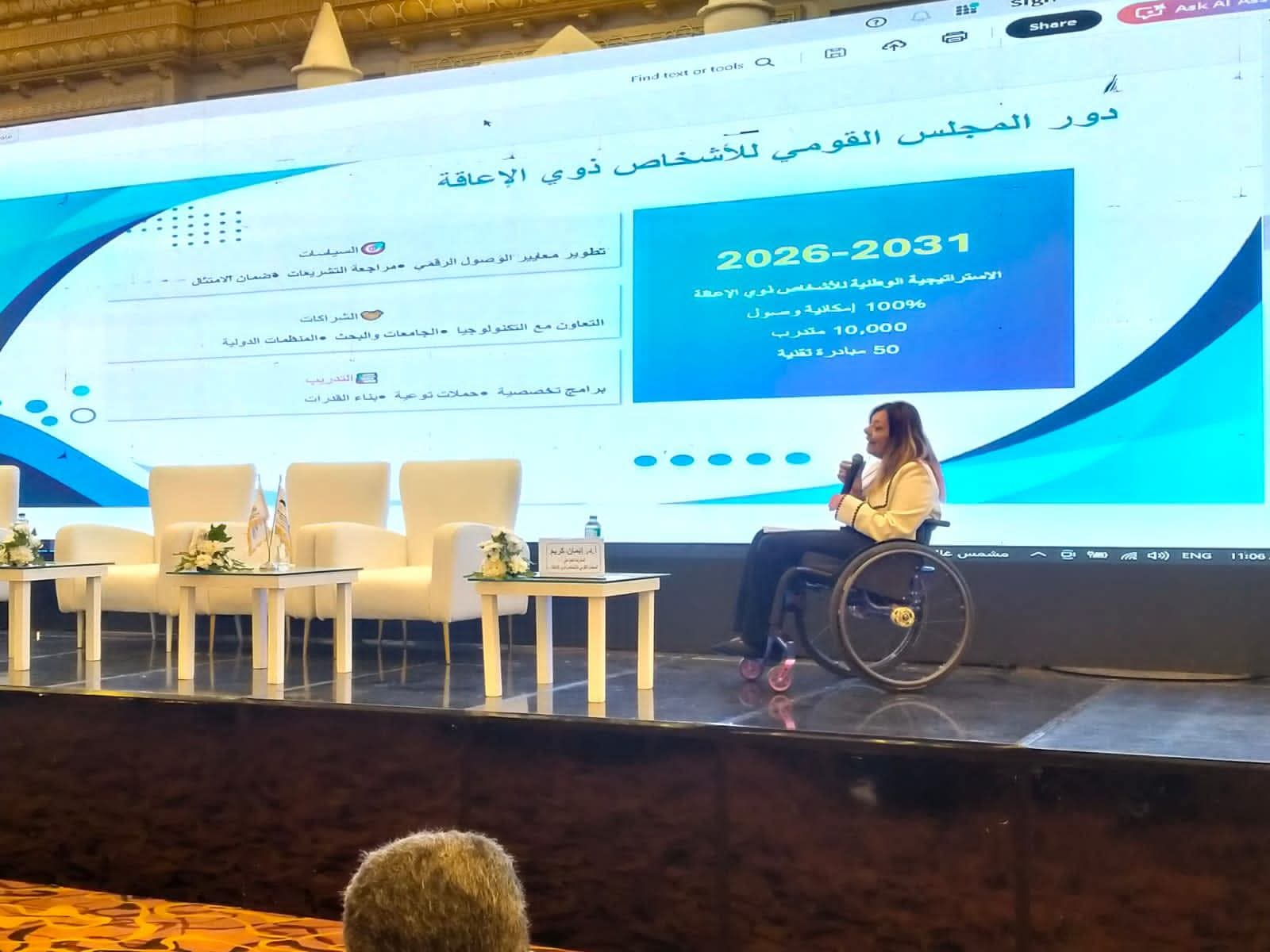

Dr. Eman Karim, Acting Head of the National Council for Persons with Disabilities (NCPWD), emphasized that digital accessibility is one of the most powerful tools for empowerment, supporting the social inclusion and full participation of persons with disabilities while enhancing their independence and dignity.
Her remarks came during her participation in the WISE-AI 2025 Conference on Women’s Empowerment in Artificial Intelligence, held under the theme “Inclusion, Integration, and Empowerment.”

Inclusive AI as a driver of social inclusion
Dr. Karim stated that inclusive artificial intelligence represents a genuine opportunity to achieve inclusion, integration, and empowerment for all segments of society, particularly persons with disabilities. She highlighted that Egypt has firmly embedded the concept of inclusive AI within its Digital Transformation Strategy 2030, noting that artificial intelligence has become a transformative force across various aspects of daily life.
She pointed out that the importance of inclusive AI is underscored by global figures, with approximately 1.3 billion persons with disabilities worldwide, making accessibility not only a social responsibility but also a critical development priority.
Legal framework and digital access challenges
During the conference, Dr. Karim outlined the concept of technological accessibility and reviewed Egypt’s legal framework governing it, particularly Law No. 10 of 2018 on the Rights of Persons with Disabilities. She addressed key issues related to digital access, including existing challenges such as the digital divide and the lack of adequate representation of persons with disabilities in AI training datasets.
She also highlighted the opportunities offered by smart assistive technologies in enhancing employment prospects, economic empowerment, independence, and human dignity for persons with disabilities.
National efforts and regional leadership
Dr. Karim discussed the principles of inclusive AI and its practical applications in supporting different types of disabilities. She highlighted the role of the National Council for Persons with Disabilities in developing digital accessibility standards, reviewing relevant legislation to ensure inclusivity, and building partnerships with technology companies, universities, research centers, and international organizations.
She further emphasized the Council’s efforts in specialized training, awareness campaigns, and capacity building, aimed at promoting inclusive digital practices nationwide.
Besides, Dr. Karim affirmed that Egypt is a regional leader in leveraging artificial intelligence to empower persons with disabilities. National initiatives include the launch of pioneering smart applications, the provision of government services online in multiple accessible formats — including sign language — and the availability of legal documents in Braille, audio, and electronic formats.
These efforts, she noted, reflect Egypt’s national vision to build an inclusive society where no one is left behind.
Recommendations for an inclusive digital future
In closing, Dr. Karim presented several practical recommendations to advance inclusivity in artificial intelligence. These include integrating digital accessibility standards from the earliest stages of design, issuing supportive legislation and incentives for companies, embedding inclusivity principles in educational curricula, encouraging private-sector investment in assistive technologies, and ensuring the active participation of persons with disabilities in AI design and development.
She concluded by reaffirming the principle “Nothing about us without us,” stressing that meaningful participation is essential to building a fair and inclusive digital future for all.