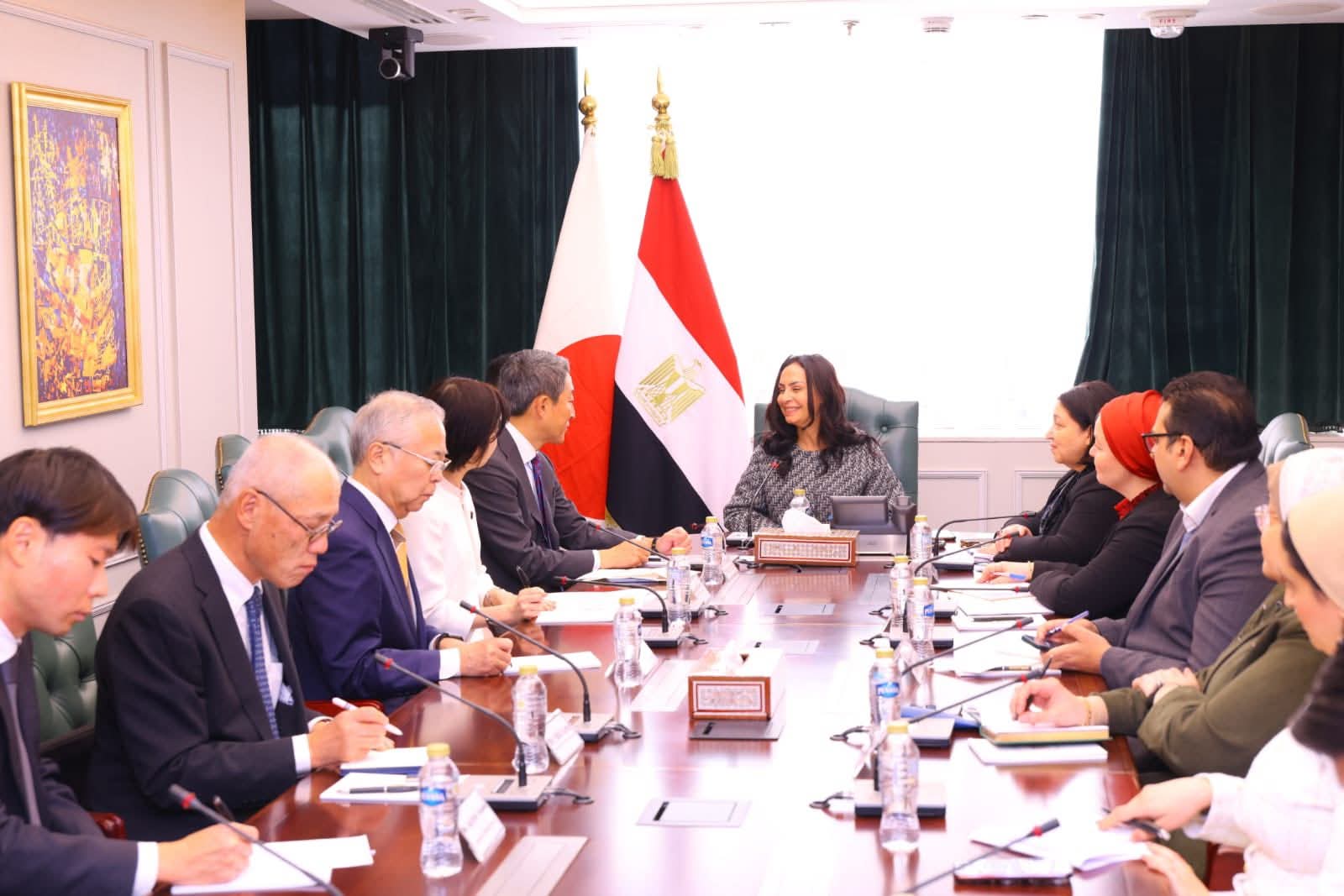

Egypt’s Minister of Social Solidarity, Dr. Maya Morsy, on Tuesday received a high-level delegation from Japan’s House of Councillors, accompanied by Japanese Ambassador to Egypt Iwai Fumio, in a meeting that underscored the growing strategic partnership between Cairo and Tokyo—particularly in early childhood development, elderly care, and social protection.
The meeting was attended by Eng. Marguerite Sarofim, Deputy Minister of Social Solidarity; Randa Fares, Advisor to the Minister for Family, Women and Child Health and Development and Director of the “Mawadda” Program; and Amira Taj El-Din, Director General of International Relations and Agreements at the ministry’s headquarters in Egypt’s New Administrative Capital.

Welcoming the Japanese delegation, Dr. Morsy praised the depth and momentum of Egyptian-Japanese relations, describing them as a model of sustained cooperation across development sectors. She emphasized that the partnership reflects shared values around human development and long-term investment in people.
Early Childhood and Elderly Care
Discussions focused on expanding bilateral cooperation in early childhood development and elderly care, alongside a review of Japanese-funded development projects currently implemented in Egypt.
Dr. Morsy expressed Egypt’s strong appreciation for cooperation with Japan on the National Early Childhood Development Project, calling it one of the ministry’s most successful partnerships with the Japan International Cooperation Agency (JICA) and the Japanese Embassy in Cairo. She highlighted Egypt’s benefit from Japan’s globally recognized experience in education and early childhood investment as a cornerstone of sustainable development.
“The Early Childhood Quality Improvement Project represents a real success story of technical cooperation and knowledge exchange between our two countries,” she said, noting its comprehensive approach that combines infrastructure, educational materials, caregiver training, and monitoring and evaluation systems.
Applying the Japanese Model in Egypt
The minister also highlighted the annual Japanese training programs that enable Egyptian professionals to travel to Japan and gain hands-on experience in early childhood development and disability services. Graduates of these programs, she said, have already begun applying their knowledge in Egypt—most notably in the nursery recently opened at the Ministry of Social Solidarity in the New Administrative Capital.
Similar nurseries have been established at the Ministries of Justice and Social Solidarity, with upcoming openings planned at the Ministries of Irrigation and Health. These facilities incorporate elements of the Japanese educational approach adapted to the Egyptian context, including learning through play and innovative methods for developing children’s skills at an early age.
Data-Driven Reform of Egypt’s Nursery System
Dr. Morsy revealed that Egypt conducted its first-ever national census of nurseries in 2025, marking a turning point in early childhood policy. The census identified 48,225 nurseries nationwide, serving more than 1.7 million children.
“These results represent the starting point for a new phase of targeted and evidence-based development,” she said, stressing that Egypt’s priority is not unplanned expansion, but strategic growth and improved service quality. Expanding and adapting the Japanese quality model within the Egyptian context, she added, is central to the next phase of joint work, which is already being piloted in nine governorates.
Interest in Japan’s Experience in Elderly Care
The minister also expressed Egypt’s interest in learning from Japan’s advanced elderly care systems. Egypt has recently enacted a law to protect the rights of senior citizens and is finalizing its executive regulations, while studying international best practices to ensure high-quality care for older adults.
In addition, Dr. Morsy outlined the ministry’s efforts—alongside national partners—to combat violence against women. She highlighted Egypt’s National Council for Women as the country’s official mechanism for women’s empowerment, as well as the ministry’s women’s shelter and guidance centers and the preventive “Mawadda” program, which prepares young people for marriage.
Japanese Delegation Praises Egypt’s Commitment
Members of the Japanese House of Councillors delegation expressed their appreciation for the strong Egyptian-Japanese cooperation in early childhood development, commending Egypt’s adoption of the Japanese vision in this field. They also praised the Ministry of Social Solidarity’s commitment to early childhood, elderly care, and combating discrimination against women—not only in Egypt, but across the wider region.
Finally, the delegation affirmed Japan’s readiness to deepen cooperation with Egypt in elderly care, citing Japan’s comprehensive senior care programs as a promising area for future partnership.