
The National Council for Women (NCW) took part in the second day of the regional workshop titled “Paid Leave and Flexible Work Arrangements: Advancing Family Well-Being and Gender Equality.” The Council contributed to two key sessions that brought together lawmakers, policy experts, and representatives from international organizations to discuss legislative reforms and best practices for supporting working families.
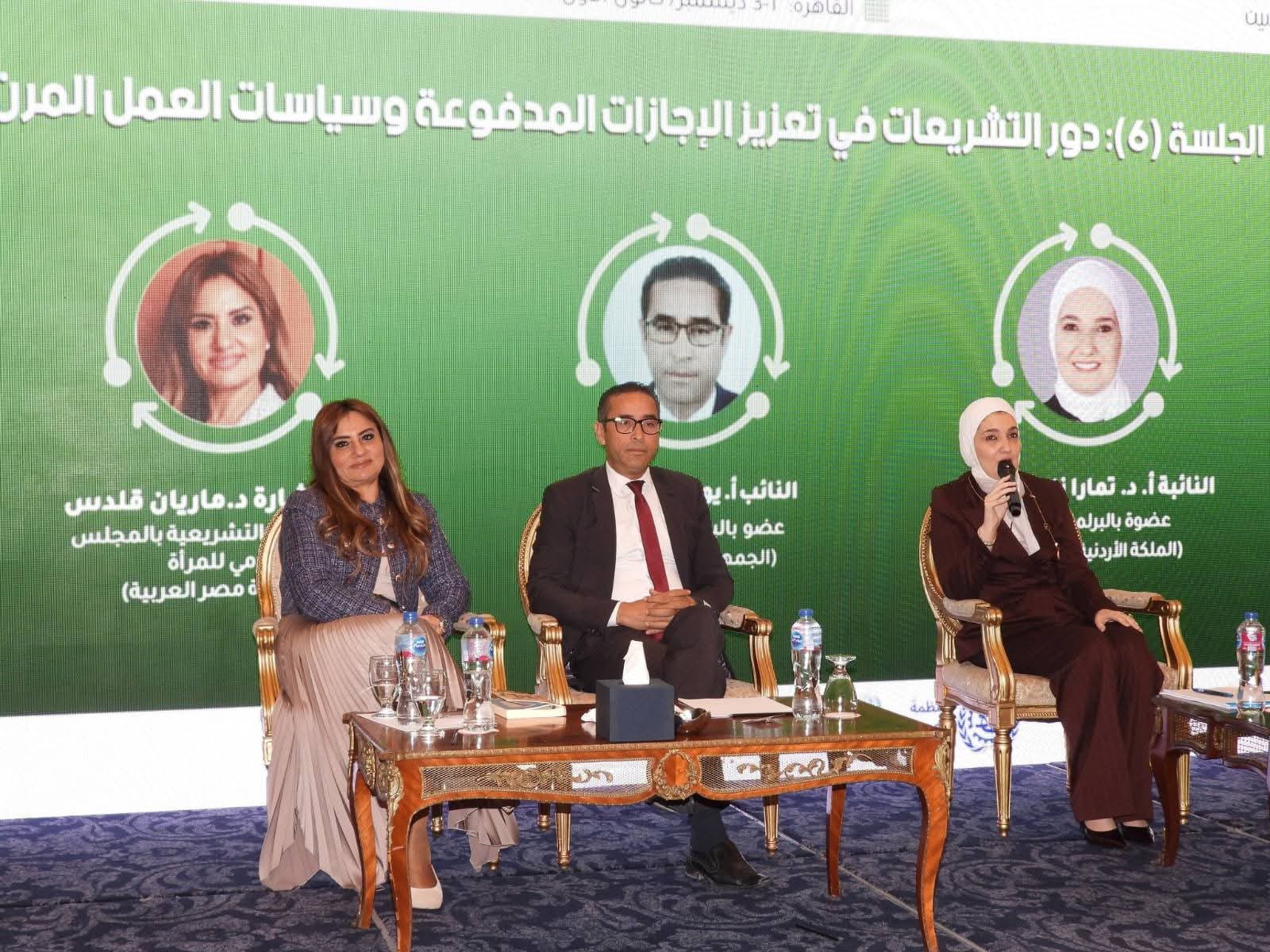
During the sixth session, “The Role of Legislation in Enhancing Paid Leave and Flexible Work Policies,” the NCW was represented by Counselor Marian Kaldas, member of the Council’s Legislative Committee. She was joined by Jordanian Member of Parliament Tamara Nasreddin, Tunisian Parliamentarian Youssef Tarshoun, and UN Women care-economy expert Suhail Abu Al-Samid.

Kaldas reviewed the new Egyptian Labor Law, describing it as a direct reflection of the state’s political will to empower women. She highlighted Article 5 of the Constitution, which emphasizes the family as the foundation of society and obliges the state to preserve its stability. She noted that the NCW played a significant role in shaping the new law in alignment with the National Strategy for the Empowerment of Egyptian Women 2030, particularly through strengthening the care economy to help women balance professional and family responsibilities.
She also drew attention to Articles 96 through 100, which introduce various flexible work modalities—such as remote work, part-time roles, and job-sharing—designed to enhance women’s participation in the labor market and advance economic empowerment. The law grants several key benefits for women, including four months of maternity leave and the right to take up to two years of unpaid leave on three occasions throughout their career without affecting promotion opportunities.
In the fifth session, “Best Workplace Practices in the Public and Private Sectors,” the NCW was represented by Zeina Ashraf Tawakkol, Rapporteur of the Health and Population Committee and Executive Director of Differently abled (Qadroon bel Ekhtelaf) Fund, with Council member Dr. Suzanne Al-Qaliny also in attendance. Participants joining virtually included Ghada Hammouda, Chief Sustainability and Marketing Officer at Qalaa Holdings; Anas Al-Sharif, Corporate Communications and Sustainability Specialist at Zain; Mohsen Faten from IKEA’s Marketing Department; and UN Women expert Suhail Abu Al-Samid.
Tawakkol outlined the challenges faced by both public and private sector companies in implementing flexible work systems. She highlighted the importance of developing internal policies that support working women—policies that not only enhance women’s participation in the labor market but also strengthen workplace productivity and well-being. She presented successful examples from regional and international private-sector companies that have adopted women-friendly policies such as extended paid leave, flexible hours, support for workplace nurseries, and stronger paternal-leave measures to encourage shared family responsibilities.
The NCW emphasized that effective workplace reforms, coupled with supportive legislation, are essential to achieving true gender equality and enabling women to fully participate in economic life.