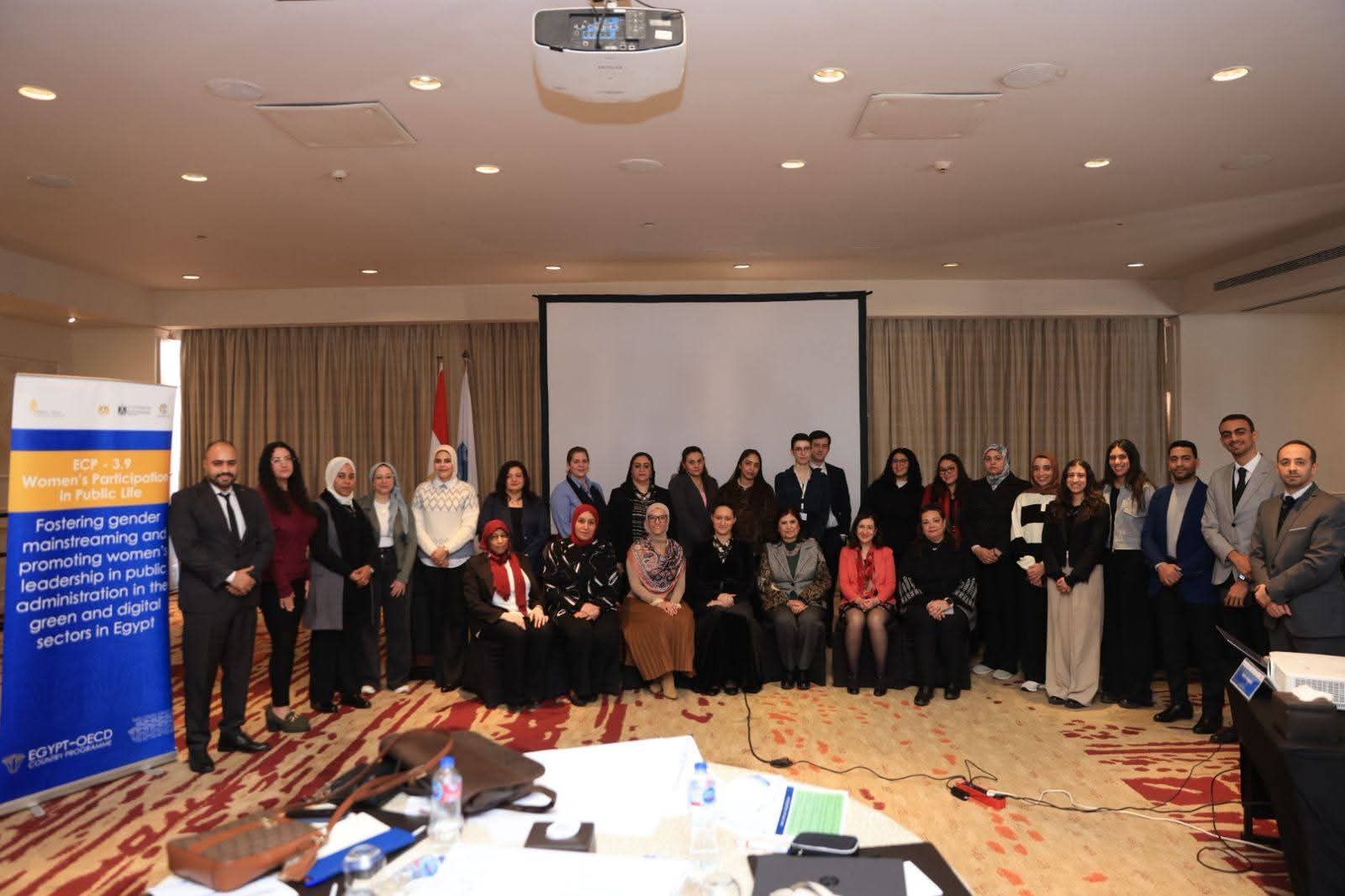

Egypt’s National Council for Women, in cooperation with the Ministry of Planning, Economic Development and International Cooperation and the Organization for Economic Co-operation and Development (OECD), convened the second and final workshop titled “Women’s Participation in Public Life: Strengthening and Promoting Women’s Leadership in Public Administration in the Digital and Green Sectors.”
The event was held under the OECD’s Egypt Country Programme and focused on translating structural reform commitments into practical policy tools that advance gender equality across digital and green transitions.

From Structural Reform to Practical Implementation
During the opening session, Dr. Nesreen El-Baghdadi, Vice President of the National Council for Women, expressed appreciation to the Ministry of Planning and the OECD for their continued support of Egypt’s structural reform agenda and efforts to promote women’s empowerment.
She described the workshop as a key milestone in moving toward practical implementation, marked by the presentation of the final version of a comprehensive operational guide designed to support policymakers in integrating women’s needs into public policies.
El-Baghdadi emphasized that Egypt is undergoing significant transformations in both the green economy and digital transition, stressing the importance of ensuring women’s full participation in policy design, implementation, leadership positions and decision-making roles.
Dr. Heba Youssef, Head of the Country Programme Follow-up Unit at the Ministry of Planning, stated that the guide is based on international best practices and aims to empower women leaders while strengthening institutional coordination. She noted that approximately 10% of Egypt’s total investment plan allocations are directed toward women and children, reflecting the government’s commitment to gender-responsive budgeting.
Amira Tlili, Policy Analyst at the OECD, said the guide builds on the organization’s 2023 gender mainstreaming framework and includes practical tools and a self-assessment model to help government entities identify strengths and gaps while developing flexible, evidence-based policies.
Green Transition as an Opportunity for Gender Equality
During the first session, Julia Morando, Policy Analyst at the OECD, emphasized that the green transition represents a genuine opportunity to advance gender equality and mainstream gender perspectives within public policies.
She noted that the OECD provides specialized tools to support women’s participation and confirmed that the final version of the guide—structured around four chapters—will help institutions assess performance, identify weaknesses and benefit from international best practices.
In the second session, Sarah El Battouty, member of Egypt’s National Council for Women, highlighted the intersection between climate change and women’s issues. She stressed that women are among the groups most affected by climate impacts, making their participation in technology and innovation sectors essential.
El Battouty underscored the critical role of rural women in food and water security and called for their inclusion to ensure a just and equitable transition toward a sustainable economy.
Dr. Hoda Darwish, Adviser to the Minister of Communications and Information Technology for Digital Community Development, said digital transformation must place women at the center of its processes. She highlighted the “Qodwa-Tech” initiative, launched in 2019, which supports women’s technological and economic empowerment, with a focus on digital marketing and artificial intelligence tools.
Valérie Plomb, Head of the Office for Gender Equality and Anti-Discrimination in France, concluded the session by emphasizing that accurate data on women’s participation in the digital and green sectors is fundamental to designing effective policies. She called for intensified efforts to increase women’s representation and remove barriers limiting their advancement.
Impact Assessment and Evidence-Based Policymaking
In the third session, Dominique Hack of the Federal Performance Management Division at the Austrian Federal Chancellery emphasized the importance of adopting impact-based policymaking, particularly regulatory impact assessments that prioritize gender equality within evaluation criteria.
Julia Stramer, also from Austria’s Federal Performance Management Division, highlighted the importance of focusing on education, employment and regulatory frameworks. She stressed that accurate data and effective institutional cooperation are essential to measuring the true impact of public policies.
Aya Salama, Impact Policy Analyst at the Egyptian Lab for Impact Measurement, presented the lab’s experience and the “Tahwisha” program, implemented in partnership with the National Council for Women and the Central Bank of Egypt. She described impact measurement as a critical tool for maximizing the outcomes of economic empowerment programs.
The workshop concluded with remarks from Counselor Dr. Marian Kaldas, member of the National Council for Women, who emphasized that integrating women’s needs into impact assessments and policymaking is an economic necessity for achieving sustainable growth, particularly in renewable energy and sustainable agriculture.
She stressed the importance of establishing clear institutional frameworks and strengthening coordination among relevant stakeholders to ensure meaningful and sustainable women’s empowerment.
As Egypt accelerates its digital and green transitions, officials and international partners reaffirmed that embedding gender equality into policymaking is not only a social imperative but also a strategic driver of inclusive and sustainable development.