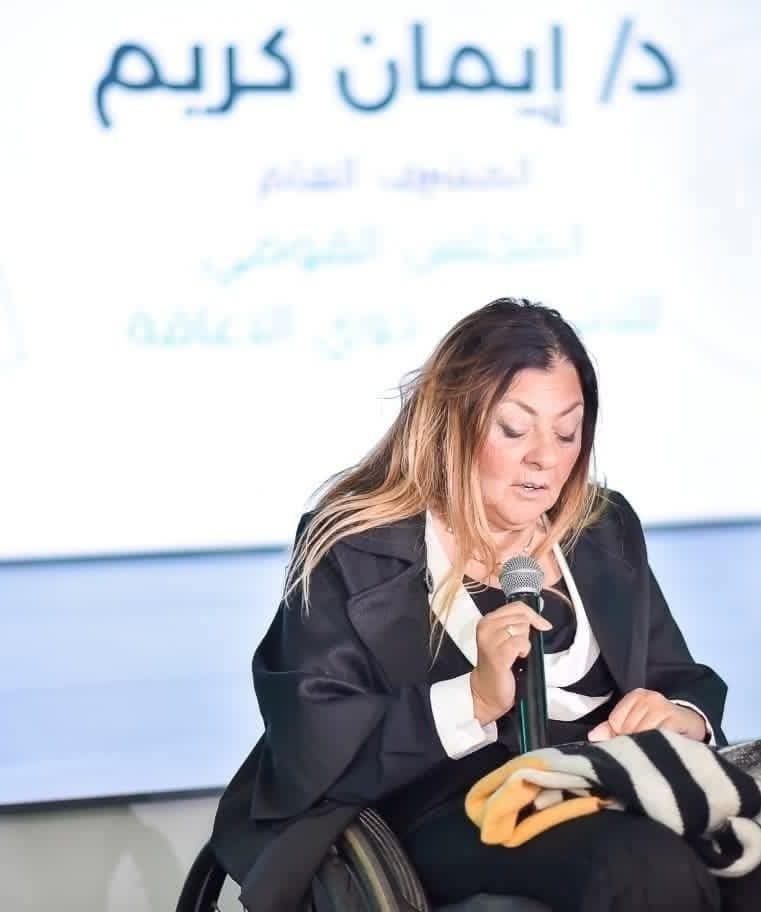

In a significant milestone for inclusive development in the Arab region, Dr. Eman Kareem, General Supervisor of Egypt’s National Council for Persons with Disabilities (NCPD), participated virtually today in the Regional Conference for the Launch of the Arab Charter on the Inclusion of Persons with Disabilities in Employment and Entrepreneurship. The event was convened by the United Nations Economic and Social Commission for Western Asia (ESCWA) in Beirut, under the theme: “Towards Inclusive Employment and Entrepreneurship Systems in the Arab Region: Challenges and Solutions.”
The conference brought together regional policymakers, development experts, and civil society leaders to exchange best practices, tackle persistent barriers, and drive forward a unified approach to economic inclusion for persons with disabilities.

Egypt’s Strategic Empowerment Vision
Dr. Kareem’s intervention underscored Egypt’s strategic framing of disability inclusion not merely as a rights-based obligation, but as a developmental and economic priority. She reiterated that economic empowerment of persons with disabilities is central to Egypt’s Vision 2030, reflecting a long-term investment in national human capital and sustainable growth.
National Initiatives Driving Change
Among the key initiatives highlighted was the national program “My Family, My Strength”, launched in 2023 under the patronage of Egypt’s First Lady, Entissar El Sisi. The initiative provides persons with disabilities vocational training in traditional crafts and professions, enabling them to become economically self-reliant. It also includes awareness campaigns aimed at transforming family and societal perceptions, with more than 5,000 families already engaged.
Dr. Kareem also unveiled Egypt’s newest inclusive entrepreneurship project, “Invest in Yourself,” which launched on October 20, 2025, in partnership with the Small and Medium Enterprises Development Authority. The initiative began concurrently in Alexandria, Sohag, and Kafr El-Sheikh, offering training modules in entrepreneurial thinking, business planning, and financial literacy—including green business models and digital marketing. The program is set to expand into ten additional governorates, including Aswan, Matrouh, the Red Sea, and New Valley, ensuring nationwide reach.
On the employment front, Egypt has implemented Law No. 10 of 2018, which mandates a 5% employment quota for persons with disabilities in the private sector. This legal foundation has been supported by on-the-ground programs such as “Egypt Is More Beautiful with You,” a vocational training initiative conducted in partnership with 25 private sector companies. To date, 2,500 individuals have completed 45 training cycles under this program.
In parallel, the NCPD has focused on supporting entrepreneurs through increased market access. Between 2023 and 2024, the Council facilitated 39 national exhibitions, enabling 920 entrepreneurs with disabilities to showcase and sell their products. Moreover, through the “Our Craft Is in Our Heritage” initiative, implemented jointly with the Ministry of Culture, individuals received training in traditional handicrafts, linking heritage preservation with economic empowerment.
Mainstreaming Inclusion Across National Policy
Dr. Kareem emphasized the strategic integration of disability inclusion across Egypt’s core policy frameworks. Persons with disabilities are explicitly included in the National Human Rights Strategy (2021–2026), the National Strategy for the Empowerment of Women 2030, and Egypt’s Climate Strategy 2050. A key development is the ongoing formulation of the National Disability Strategy 2025–2030, commissioned by a Cabinet decree in 2024, which is expected to provide a comprehensive roadmap for inclusive development.
Innovative Approaches to Accessibility and Inclusion
The Council’s efforts extend into financial inclusion, with 96 nationwide awareness sessions conducted in partnership with major financial institutions including Banque Misr and the National Bank of Egypt. These sessions reached nearly 9,720 individuals with disabilities, promoting access to banking services and financial independence.
In terms of physical accessibility, more than 400 engineers from local authorities have been trained on Egypt’s Accessibility Code, supporting the roll-out of accessible public infrastructure. A pilot program, “Sustainable Cities for All,” was launched in Ismailia as a model for disability-friendly urban planning.
Digital accessibility has also seen progress through the DAISY project, implemented in collaboration with the Japanese government to produce accessible audiobooks. The Council has produced election materials in Braille, and deployed 40 sign language interpreters at public events, including the Cairo International Book Fair, enhancing participation in public life.
On the political front, the “Your Voice, Your Right” campaign reached 7,500 individuals in the lead-up to the 2024 presidential elections, encouraging political participation among persons with disabilities and reinforcing civic inclusion.
Call to Action: Advancing Regional Unity Through Inclusion
Concluding her remarks, Dr. Kareem urged Arab states to sign and operationalize the newly launched Arab Charter, highlighting the importance of collective progress in inclusive employment and entrepreneurship. She emphasized Egypt’s readiness to share its policy models and implementation strategies with regional partners, reinforcing the idea that economic empowerment of persons with disabilities is not an optional benefit but a development necessity and a long-term investment in social and economic resilience.
Conclusion
Egypt’s active participation in the ESCWA regional conference and its role in launching the Arab Charter for Inclusive Employment and Entrepreneurship solidifies its leadership in disability-inclusive development. Through a combination of legislative reforms, multisector partnerships, and scalable national programs, Egypt is demonstrating that meaningful inclusion is achievable—and essential. As Arab states convene to shape a shared future, Egypt offers a model of integration, innovation, and determination in ensuring that no one is left behind.