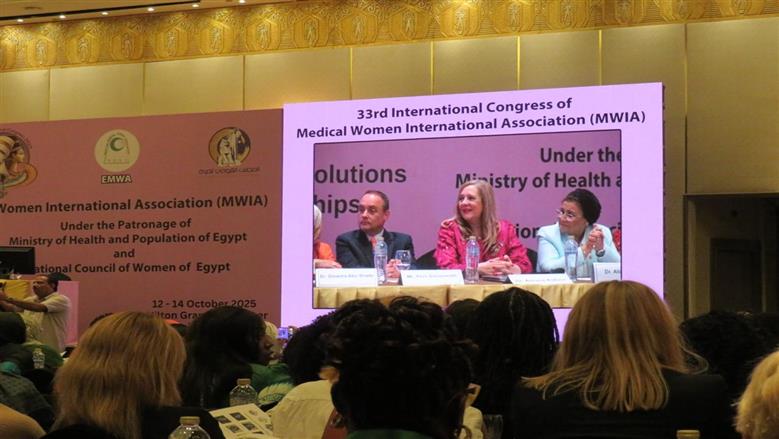

Dr. Abla El-Alfi, Egypt’s Deputy Minister of Health and Population and Supervisor of the National Population Council, delivered a powerful address at the opening session of the 33rd Congress of the Medical Women’s International Association (MWIA), held under the patronage of the Ministry of Health and Population and the National Council for Women.
In her remarks, Dr. El-Alfi emphasized that recognizing female physicians is more than symbolic — it honors their dual role as healers and agents of societal change. “Health and the empowerment of women are foundational to sustainable development,” she said, celebrating the legacy of pioneering Egyptian women doctors like Helena Sedraous and Nazir, who combined medicine with advocacy for human rights.

Addressing the Caesarean Crisis and Promoting Natural Birth
One of the key challenges highlighted by Dr. El-Alfi was the rising rate of non-medically indicated cesarean deliveries in Egypt. She stressed the importance of promoting natural birth, citing the benefits of the “golden hour” — the critical first moments after birth that support breastfeeding, maternal bonding, and neonatal health.
She outlined the Ministry’s efforts to raise awareness and reduce unnecessary C-sections, aligning clinical practice with global health standards and improving long-term outcomes for mothers and newborns.
National Initiatives for Women’s Health and Empowerment
Dr. El-Alfi showcased Egypt’s flagship health initiatives that place women’s wellbeing at the center of public policy. These include:
- The “Egyptian Women’s Health Initiative”, which has delivered free screening and treatment to millions of women for early detection of breast cancer, diabetes, hypertension, and other chronic diseases.
- The “Golden 1,000 Days” initiative, focusing on the critical window from pregnancy to a child’s second birthday — a period essential for building human capital and shaping the future health of the nation.
She underlined that empowering women through health directly supports economic productivity, family stability, and social resilience, reinforcing Egypt’s broader development goals.
Chronic Diseases, Policy Leadership, and the Role of Women in Healthcare
Dr. El-Alfi also paid tribute to Egyptian women doctors for their leadership in both clinical care and policy-making. She reiterated the Ministry’s commitment to supporting female physicians as they take on roles in health governance and strategic planning.
Chronic illnesses — from non-communicable diseases to maternal mortality — remain a global concern, she noted. Addressing these requires the full inclusion of women in shaping healthcare systems, not only as providers but as decision-makers.
A Global Call for Comprehensive Women’s Health Strategies
Positioning Egypt’s experience within a global context, Dr. El-Alfi called for international cooperation to address systemic challenges in women’s health, including gender-based violence, malnutrition, maternal deaths, and rising rates of non-communicable diseases.
She urged for a holistic approach that brings together health, education, and economic investment to deliver sustainable outcomes for women and their communities.
Closing Message: A Shared Vision for Health Equity
Dr. El-Alfi closed her speech with a strong reaffirmation of Egypt’s commitment to working with the International Medical Women’s Association and global partners to advance health equity for women around the world.
She extended her gratitude to the conference organizers and honored the dedication of every woman in medicine who, in her words, “devotes her life to serving humanity.”