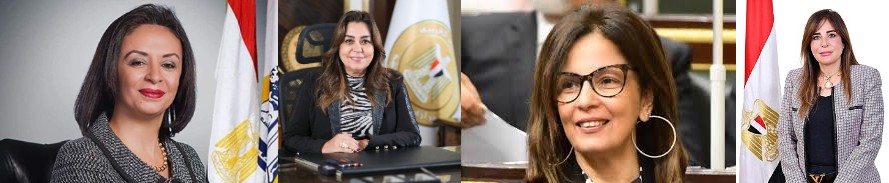

Egypt’s latest cabinet reshuffle, approved by parliament yesterday, has reinforced women’s representation in senior government positions at a time when the country faces significant economic and social challenges.
While much of the reshuffle focused on economic management amid inflationary pressures and reform commitments, the continued and strategic placement of women in core ministries stands out as a defining feature of the new government lineup.

Social and Development Policy
Among the most prominent figures in the reshuffled cabinet is Maya Morsy, appointed Minister of Social Solidarity. A well-known advocate for women’s rights and former head of Egypt’s National Council for Women, Morsy now oversees one of the government’s most sensitive and expansive portfolios.
The Ministry of Social Solidarity administers Egypt’s flagship social protection programs, including cash-transfer initiatives that support millions of low-income families. At a time when economic reforms and subsidy restructuring have increased pressure on vulnerable households, Morsy’s role is central to maintaining social cohesion and mitigating the social impact of fiscal adjustments.
Her appointment signals continuity in the government’s social welfare strategy while elevating a figure with strong international credentials and longstanding engagement in gender and development policy.
Equally significant is Dr. Manal Awad, who continues to play a leading role in local development and environmental governance. Local administration in Egypt is a critical layer of state authority, responsible for implementing national policies at the governorate and municipal levels. Awad’s leadership intersects directly with decentralization efforts, infrastructure delivery, and environmental sustainability.
As climate resilience and sustainable urban planning become increasingly urgent issues — both domestically and within global policy frameworks — her ministry operates at the intersection of governance reform and environmental responsibility.
Expanding into Strategic Sectors
The reshuffle also includes Randa El-Menshawy as Minister of Housing, Utilities and Urban Communities — one of the most economically significant ministries in Egypt. The housing portfolio oversees major infrastructure projects and urban expansion initiatives that form a cornerstone of the country’s long-term development plans.
Meanwhile, Gihane Zaki, appointed Minister of Culture, assumes responsibility for heritage preservation and cultural diplomacy. In a region where cultural influence carries geopolitical weight, the ministry plays a role not only in domestic cultural policy but also in projecting Egypt’s soft power abroad.
From Representation to Institutional Integration
Women have held cabinet roles in Egypt for years, but observers note a qualitative shift: female ministers are now embedded across portfolios that are economically, socially, and politically central to the state’s agenda.
Rather than being confined to narrowly defined “women’s affairs” roles, female leaders are shaping policy in social protection, local governance, infrastructure, environment, and cultural diplomacy — areas directly tied to economic reform, social stability, and international engagement.
This evolution reflects a broader regional trend toward increased female political participation, though Egypt’s model remains incremental rather than transformative. Women still represent a minority within the cabinet, but their presence in influential ministries underscores a steady normalization of gender diversity at the executive level.
Reform Agenda
The reshuffle unfolds amid ongoing economic reform efforts, negotiations with international financial institutions, and external pressures linked to regional instability. In this context, cabinet appointments are widely interpreted as part of a strategy to strengthen administrative performance and policy delivery.
The February 2026 cabinet reshuffle in Egypt stands out not only for its strategic realignment of ministries but also for the enhanced participation of women in leadership roles across sectors central to national development.