
At a time when global labor markets are being reshaped by technology, disruption, and shifting economic realities, the fourth edition of the Egyptian Women’s Summit delivered a clear message: building the self and intentionally designing one’s career is no longer optional—it is a necessity.
Under the patronage of Egyptian Prime Minister Dr. Mostafa Madbouly, the summit opened Saturday morning in Cairo, bringing together policymakers, educators, entrepreneurs, and thousands of young participants under the theme “Empowering Youth in STEM: The Future Is Happening Now.”

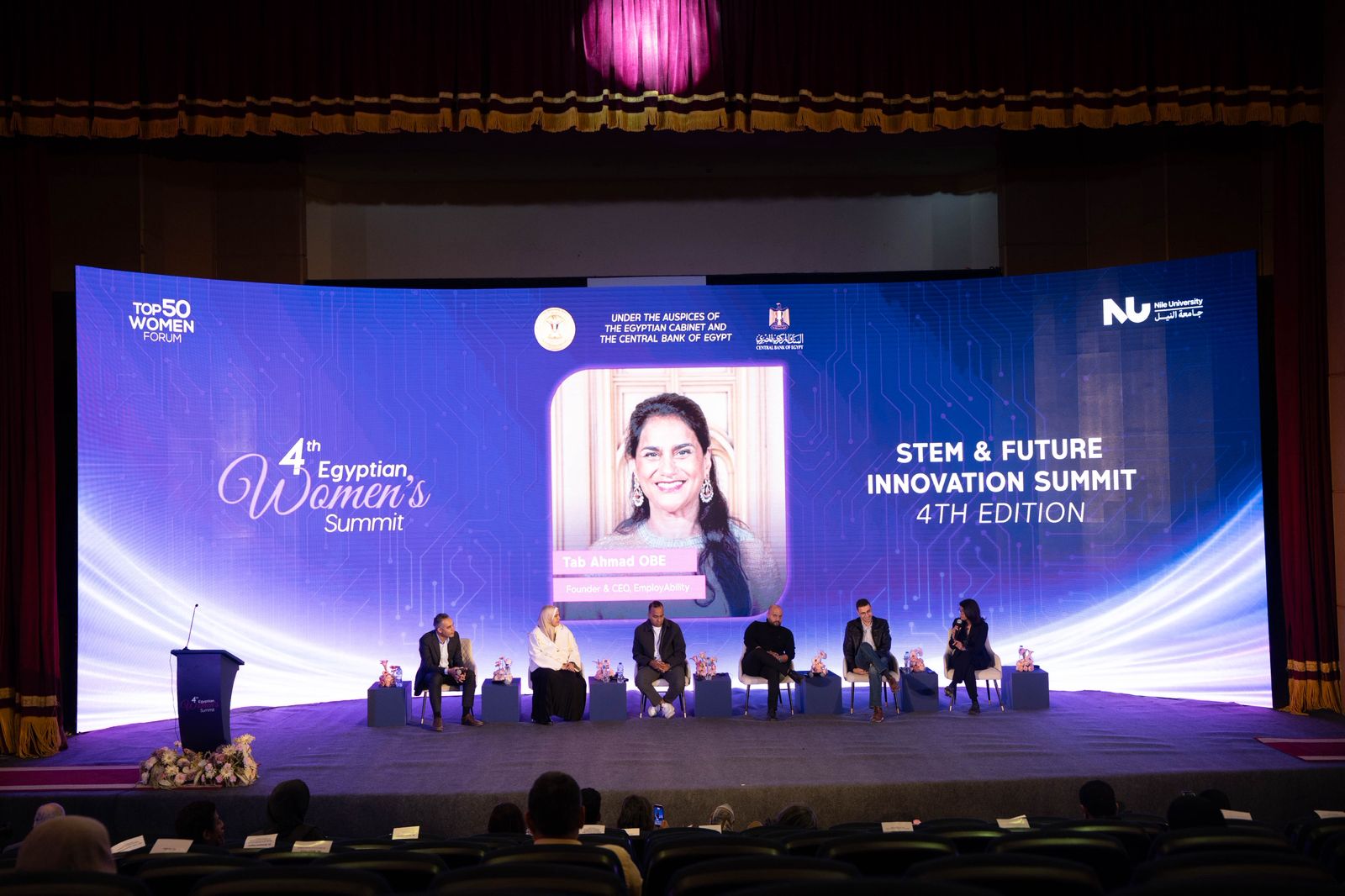
One of the summit’s most anticipated discussions, titled “The Code of Professional Life: Entrepreneurs Speak,” offered a rare, candid look into how founders navigate uncertainty, rethink traditional career paths, and turn challenges into scalable opportunities.
From Crisis to Opportunity: Logistics Born in Turbulent Times
Ahmed Doweidar, co-founder and CTO of logistics startup, Khazenly, shared how his transition from a stable consulting career at IBM to entrepreneurship was driven by foresight rather than impulse.
At the height of the COVID-19 pandemic—when global supply chains were collapsing—Doweidar identified a structural gap in e-commerce infrastructure. Khaznly emerged as a “logistics-as-a-service” platform, allowing merchants to outsource storage, fulfillment, delivery, and cash collection, while focusing on sales and growth.
By bootstrapping the company and declining early investment offers, Doweidar said Khaznly retained control over its intellectual property and gained stronger leverage later—paving the way for regional expansion, particularly into the Saudi market.
Neurodiversity: An Untapped Competitive Advantage
British entrepreneur Tup Ahmed, founder of EmployAbility and recipient of the Order of the British Empire (OBE), tackled a topic often overlooked in global hiring practices: neurodiversity.
She argued that conditions such as autism, ADHD, and dyslexia are not deficits but alternative cognitive patterns that can fuel innovation—especially in STEM fields. Traditional recruitment systems, she noted, systematically exclude this talent pool.
EmployAbility’s partnerships with global corporations including Google, Amazon, and Goldman Sachs are rooted in economic value, not charity. “Inclusive work environments are not about social responsibility alone,” Ahmed emphasized. “They are about performance, creativity, and competitive advantage.”
Virtual Labs and the Democratization of Science Education
Bridging academia and entrepreneurship, Dr. Khadija El-Badawihi, Founder of PraxiLabs, addressed one of education’s most persistent challenges: access to hands-on learning.
With physical laboratories often unavailable or under-resourced, PraxiLabs developed immersive virtual lab simulations that allow students to conduct complex scientific experiments online. What began as a response to local constraints quickly scaled globally—reaching learners in over 150 countries within two years.
Leaving a traditional academic path, El-Badawihi said, was a decision driven by impact. “Technology can turn knowledge into a universal right, not a privilege,” she said.
Speaking Gen Z’s Language, Not Outdated Curricula
For Omar El-Barbary, co-founder and CEO of OBM Education, the disconnect between academic education and labor market needs is one of the region’s most urgent problems.
Through the Taleb Super App, now serving nearly 500,000 users, OBM delivers short, market-driven courses and career guidance tailored to Generation Z’s preference for concise, practical content.
El-Barbary stressed that the goal is not just employment—but employability. “We want graduates who can activate themselves in the market, not wait for it,” he said, pointing to the company’s growing footprint in Saudi Arabia.
Reinventing Advertising Through Resource Innovation
Closing the session, Mohamed Moussa, founder and CEO of DKILO, demonstrated how innovation doesn’t always mean inventing from scratch—it can mean reimagining what already exists.
DKILO transforms everyday cars into mobile advertising platforms, creating a cost-effective marketing channel for small and medium-sized businesses while generating income for car owners. Despite early challenges in scaling the tech platform, Moussa credited persistence and iteration for the company’s survival and growth.
With expansion plans underway in Saudi Arabia and the UAE, Moussa noted that regional markets are increasingly receptive to smart, performance-based advertising models.
A Summit Bridging Policy, Education, and the Private Sector
Over two days, the Egyptian Women Summit hosted more than 6,000 participants, including ministers, ambassadors, international organization leaders, heads of 28 Egyptian and international universities, and youth delegations.
Organized by the Top 50 Most Influential Women Forum in collaboration with the National Council for Women, and hosted at Nile University, the summit aims to create a lasting bridge between academia, the private sector, and global institutions.
Key discussions focus on the future of work, STEM careers, artificial intelligence, and the skills economy—moving beyond academic credentials toward adaptability, critical thinking, and applied expertise.
The summit also marked the signing of a strategic partnership with MSMEDA, transforming the event into a long-term platform for youth empowerment, alternative financing, and entrepreneurship support.
As the global workforce continues to evolve, the stories shared in Cairo underscored a powerful takeaway: career success in the modern era is engineered—not inherited—and opportunity belongs to those willing to design their own path.