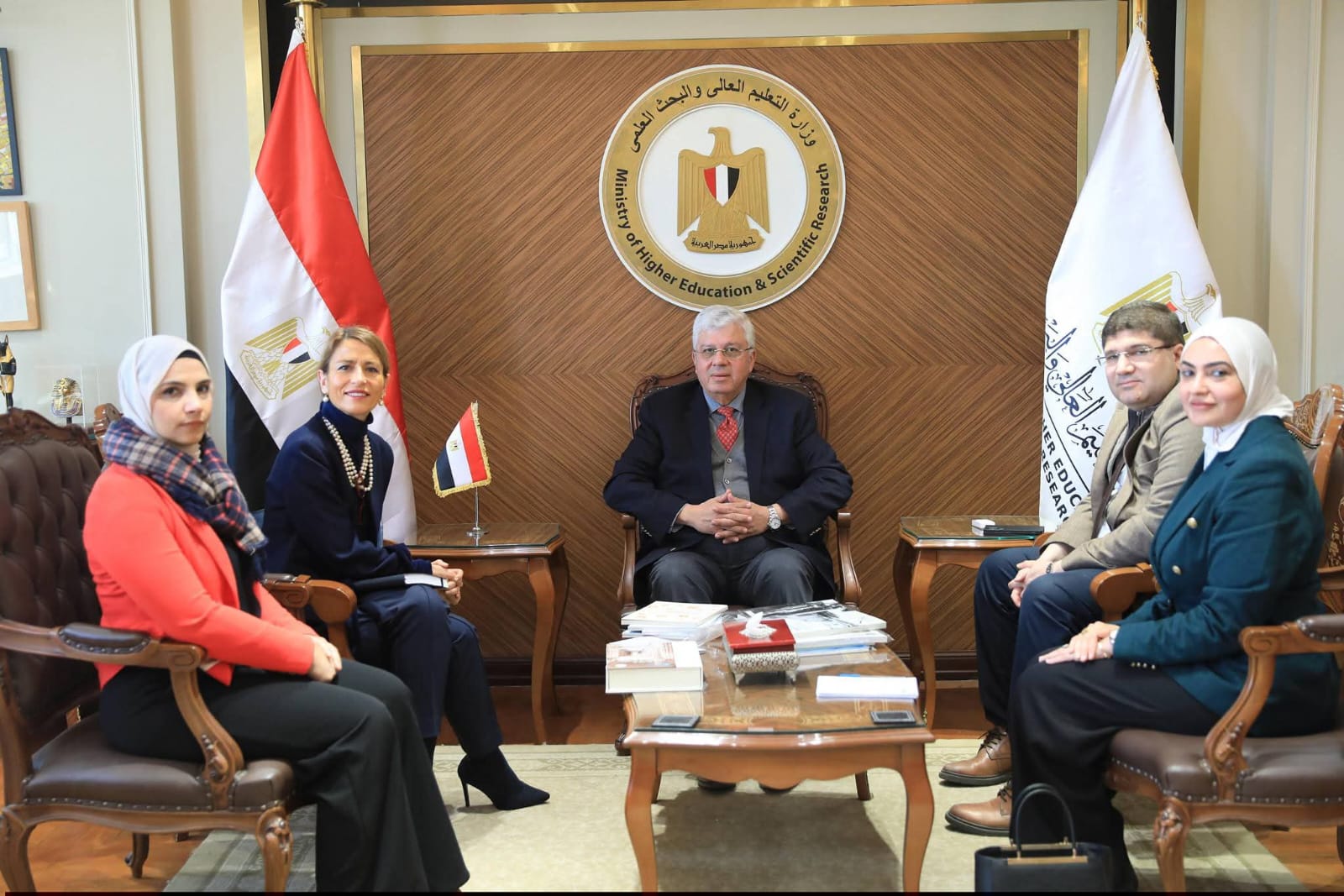

Egypt’s Minister of Higher Education and Scientific Research, Dr. Ayman Ashour, has underscored the strategic importance of micro-credentials as a key pillar of Egypt’s higher education reform during a meeting with Dr. Nuria Sanz, Director of UNESCO’s Regional Office in Cairo.
According to an official statement from the Ministry of Higher Education and Scientific Research, the meeting—held at the ministry’s headquarters in the New Administrative Capital—focused on strengthening cooperation between Egypt and UNESCO, with particular emphasis on developing and internationally recognizing micro-credential programs.

The meeting was attended by Dr. Ayman Farid, Assistant Minister for Cultural Affairs and Scholarships and Secretary-General of the Egyptian National Commission for Education, Science and Culture, and Dr. Hala Abdel-Gawad, Assistant Secretary-General for UNESCO Affairs at the Commission.
Micro-Credentials and the Future of Learning
Dr. Ashour stressed that micro-credentials represent a strategic tool within Egypt’s higher education system, supporting lifelong learning and enabling students and professionals to continuously upgrade and reskill their competencies. He noted that these flexible, skills-based programs are essential to keeping pace with rapidly changing labor market needs, technological advancement, and global economic shifts.
The minister emphasized that Egypt is keen to align its micro-credential framework with UNESCO’s international standards, ensuring global recognition and mutual accreditation. This alignment, he said, will enhance the global competitiveness of Egyptian graduates and support Egypt Vision 2030, which prioritizes innovation, employability, and knowledge-based development.
Strengthening UNESCO Cooperation
Beyond micro-credentials, the talks explored ways to deepen collaboration in higher education, scientific research, and innovation. Dr. Ashour highlighted the importance of strengthening the role of UNESCO’s Cairo office to better address Egypt’s national priorities and the broader needs of the Arab and African regions, particularly through capacity building and enhanced institutional coordination.
Both sides discussed expanding joint initiatives, including the development of human resources within the UNESCO office, improving operational efficiency, and widening cooperation with universities and research centers.
Universities, Research, and Regional Impact
The meeting also reviewed plans to expand UNESCO Clubs across Egyptian universities, creating platforms that encourage student engagement, global citizenship, and innovation. Support for regional centers specializing in water resources and environmental sustainability was also discussed, reinforcing Egypt’s role as a regional hub for scientific research and development.
In addition, the two sides examined prospects for cooperation in addressing regional challenges, including reconstruction and development efforts in conflict-affected areas such as Gaza and Sudan, as well as strengthening research in health, technology, architecture, and the protection of Arab and Islamic cultural heritage.
UNESCO Commends Egypt’s Vision
Dr. Nuria Sanz praised Egypt’s leadership and proactive approach to modernizing higher education, particularly its focus on micro-credentials as a forward-looking model for skills development and lifelong learning. She reaffirmed UNESCO’s commitment to continued cooperation with Egypt, especially in building scientific capacity and expanding programs that deliver measurable outcomes in education, research, and innovation.
She also highlighted the importance of increasing researcher and scientist participation in UNESCO-supported initiatives, contributing to sustainable development goals and reinforcing Egypt’s growing regional and international influence.