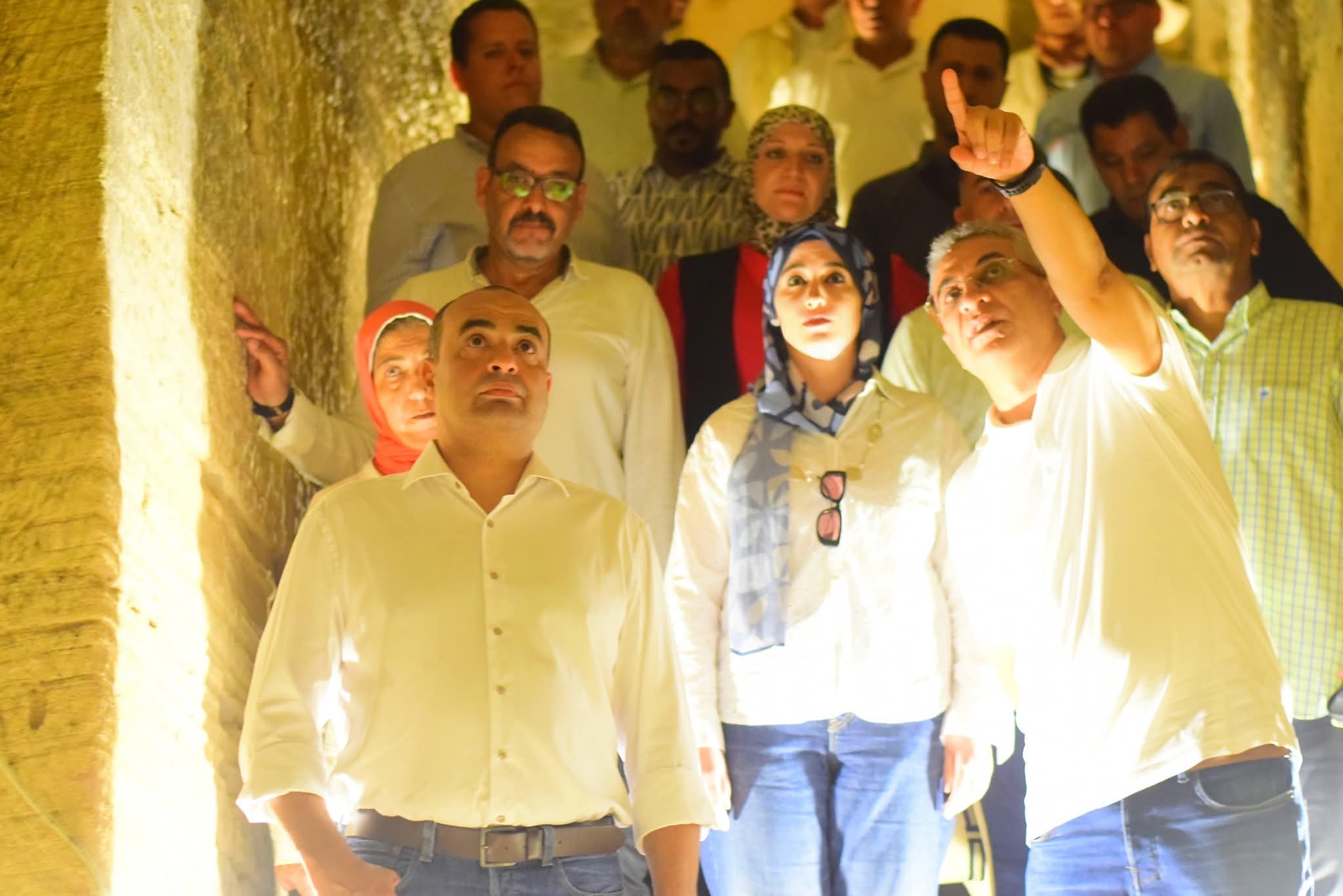

As part of its ongoing strategy to enhance the visitor experience and preserve Egypt’s rich cultural heritage, senior officials from the Ministry of Tourism and Antiquities have conducted a high-level inspection tour of several key archaeological sites in Alexandria. The visit aimed to review progress in ongoing restoration and development efforts and ensure that service and accessibility upgrades align with international standards.
Deputy Minister of Tourism and Antiquities, Yomna El-Bahar, and Dr. Mohamed Ismail Khaled, Secretary-General of the Supreme Council of Antiquities, led the visit, which covered prominent landmarks such as Kom El Shoqafa, Pompey’s Pillar and the Serapeum, and the Roman Theatre at Kom El-Dikka.

The tour focused on evaluating the latest developments in site restoration, visitor pathways, and enhanced amenities, while also reviewing preparations to ensure the sites are accessible for all, including visitors with disabilities, in line with Egypt’s commitment to accessible tourism.
Accompanying the delegation were key officials from the Ministry, including Dr. Moamen Osman, Head of Projects Sector; Mohamed Abdel Badi, Head of the Egyptian, Greek, and Roman Antiquities Sector; Dr. Hesham Hussein, Head of the Central Department for Lower Egypt Antiquities; and Dr. Hossam Ghuneim, General Director of Antiquities in Alexandria.
At Kom El Shoqafa, one of Egypt’s most iconic Greco-Roman catacombs, the delegation reviewed restoration of archaeological pieces and their placement on newly constructed plinths in the open-air exhibition area. At Pompey’s Pillar and the Serapeum, efforts to improve the site’s infrastructure and visitor journey were assessed. Meanwhile, the team also visited the Roman Theatre, where development includes a new gate connecting to Safia Zaghloul Street and the integration of an open museum for underwater antiquities, aimed at connecting the ancient landmark with its urban surroundings.
Dr. Khaled praised the ongoing restoration works and emphasized their importance in preserving Alexandria’s cultural identity and boosting its status as a leading cultural and tourist destination. He instructed teams to accelerate work on developing the open-air museum displays and ensure comprehensive interpretive signage in multiple languages, enhancing understanding of the sites for international visitors.
He also called for upgrades to the protective canopy over the main burial shaft at Kom El Shoqafa and reaffirmed the ministry’s commitment to high-quality restoration that balances conservation, presentation, and accessibility.
Discovered by accident in 1900, Kom El Shoqafa dates back to the late first century AD and was used until the fourth century. Its architecture uniquely blends Egyptian, Greek, and Roman styles, featuring a spiral staircase, banquet hall, and a main burial chamber. The site also houses relocated tombs such as the Tigrane Tomb, the Wardian Tomb, and the Savaggo Tomb, reconstructed on-site for preservation and public display.
The Serapeum complex, where Pompey’s Pillar stands, once served as Alexandria’s Acropolis. The pillar—nearly 27 meters tall and carved from red Aswan granite—is the tallest surviving Roman triumphal column and was erected in honor of Emperor Diocletian in the 3rd century AD.
The Kom El-Dikka archaeological area, home to the Roman Theatre, provides rare insights into the city’s urban fabric from the Hellenistic through Islamic periods. Excavations, carried out since the 1960s in collaboration with a Polish archaeological mission, have uncovered key architectural features including lecture halls, a residential district, Roman baths, cisterns, colonnaded streets, and the famous “Villa of the Birds”, known for its exquisite mosaic floors.
These developments reflect Egypt’s broader commitment to preserving its archaeological heritage while making it accessible and engaging for both local and international audiences, further positioning Alexandria as a vital destination on the global cultural tourism map.