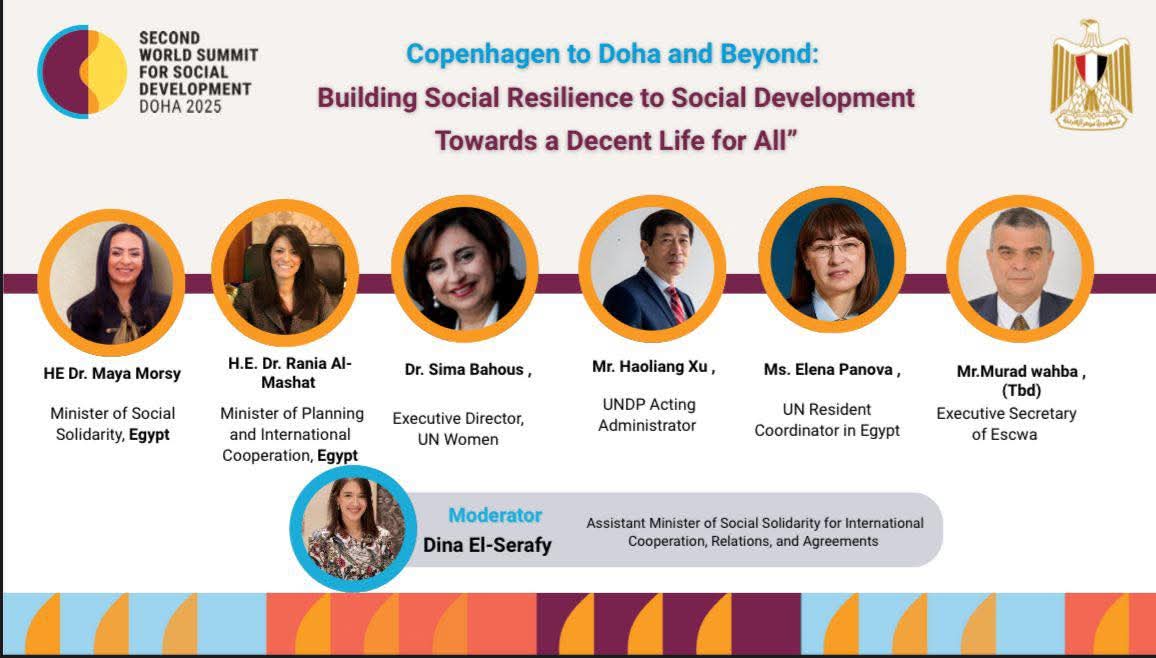

Egypt’s Ministry of Social Solidarity, led by Dr. Maya Morsy, organized a high-level national event under the title “From Copenhagen to Doha and Beyond: Building Social Resilience for Social Development Towards a Decent Life for All,” as part of the Second World Summit for Social Development, hosted in Doha on November 4, 2025.
The event brought together leading international figures including Dr. Rania Al-Mashat, Egypt’s Minister of Planning, Economic Development, and International Cooperation; Dr. Sima Bahous, UN Under-Secretary-General and Executive Director of UN Women; Mr. Haoliang Xu, UN Assistant Secretary-General and Associate Administrator of UNDP; Ms. Elena Panova, UN Resident Coordinator in Egypt; and Dr. Mourdad Wahba, Acting Executive Secretary of ESCWA. The session was moderated by Dina El-Sirafy, Assistant Minister of Social Solidarity for International Cooperation and Agreements.

Egypt’s Comprehensive Vision for Social Protection
In her opening remarks, Minister Maya Morsy welcomed participants, highlighting Egypt’s 25-year journey in building a comprehensive social protection ecosystem encompassing cash transfers, healthcare, social insurance, affordable housing, emergency aid, economic empowerment, and food assistance.
“Over the past decade, Egypt has faced regional and global challenges, yet we placed social protection at the heart of our national vision,” Dr. Morsy said, noting that Egypt’s national social protection budget has doubled to EGP 700 billion in FY 2025/2026, reflecting an unwavering commitment to social justice and human development.
“Takaful and Karama”: From Assistance to Empowerment
Dr. Morsy described the Takaful and Karama (Solidarity and Dignity) program—launched in 2015—as Egypt’s cornerstone social safety net. Initially funded at EGP 3.6 billion for one million families, it now exceeds EGP 54 billion annually, serving 4.7 million households and reaching nearly 7.8 million families over the past decade.
“This is not just a cash transfer scheme—it is a strategic investment in human capital,” she stressed. “Through health insurance, education support, food programs, literacy classes, and disability inclusion cards, Takaful and Karama ensures that protection goes hand-in-hand with empowerment.”
“Decent Life” Initiative: Transforming Rural Egypt
The minister also underscored the transformative impact of the Presidential “Hayah Karima” (Decent Life) initiative, which addresses multidimensional poverty in over 4,000 rural villages, benefiting 58 million citizens. The program integrates infrastructure upgrades, clean water access, sanitation, and social services while prioritizing women’s empowerment—who make up 75% of its beneficiaries.
She noted that the initiative embodies a shift “from welfare to capability-building,” making Egypt a regional model for inclusive, gender-sensitive development.
Building a Resilient and Adaptive Social Protection System
Dr. Morsy outlined Egypt’s ongoing work on a National Framework for Integrated Social Protection, designed to align with Egypt Vision 2030 and the UN SDGs. The framework will promote data-driven governance, digital integration, and fiscal sustainability—linking protection to economic participation, care economy growth, and decent work.
“From Takaful and Karama’s foundational cash support to the transformative scope of Decent Life, and the long-term security offered by pension and health insurance reforms—Egypt is establishing a globally recognized model for social resilience,” she said.
Global Partners Commend Egypt’s Leadership
Dr. Rania Al-Mashat highlighted Egypt’s determination to balance economic growth with social equity “Social protection is not a slogan—it is a lived reality for millions of Egyptians,” she said, emphasizing the government’s shift from protection to empowerment, particularly through Takaful and Karama and the Decent Life initiative.
Dr. Sima Bahous, UN Under-Secretary-General and Executive Director of UN Women, commended Egypt as “a great nation and a model for gender equality and women’s empowerment.” She stressed the importance of ensuring that social protection systems respond to women’s needs, especially those in informal and unpaid care sectors.
Mr. Haoliang Xu, UN Assistant Secretary-General and Associate Administrator of UNDP, praised Egypt’s leadership, stating that “Egypt offers positive experiences and successful models for social protection and social development.”
He outlined three priorities for advancing global protection frameworks:
- Strengthening governance, capacity building, and policy integration;
- Expanding digitalization and financial accessibility;
- Building robust, shock-responsive protection systems.
Dr. Mourdad Wahba of ESCWA echoed the call to enhance data-driven policymaking and South-South cooperation, underscoring the importance of linking care services with economic empowerment.
A Regional Blueprint for Human Development
Egypt’s participation in the Doha Social Development Summit reinforces its position as a regional leader in social policy innovation, demonstrating how integrated protection systems, digital governance, and community empowerment can create resilient, equitable societies.
As Dr. Morsy concluded “We are committed to ensuring that every Egyptian enjoys a life of dignity and opportunity—our social protection system is not only inclusive and adaptable but deeply rooted in solidarity and human worth.”