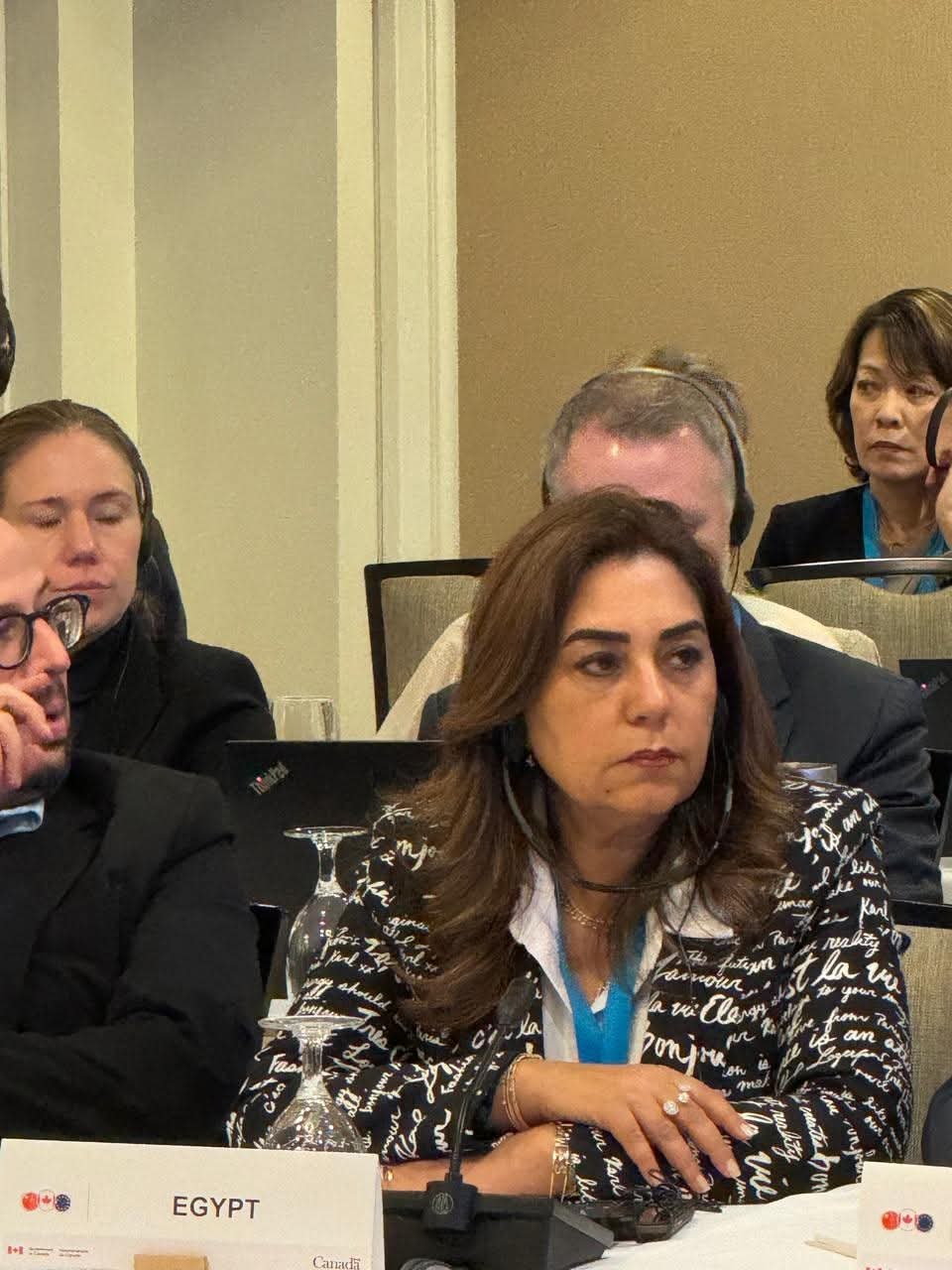

Egypt reaffirmed its regional leadership in climate action as Dr. Manal Awad, Minister of Local Development and Acting Minister of Environment, took part in the 9th Ministerial Meeting on Climate Action (MoCA9) held in Canada from October 31 to November 1, 2025. The high-level gathering, hosted by the Government of Canada, brought together environment and climate ministers from the European Union, China, and several developing nations to assess progress toward the goals of the Paris Agreement.
The opening session featured remarks from Julie Dabrusin, Canada’s Minister of Environment and Climate Change, Huang Runqiu, China’s Minister of Ecology and Environment, and Wopke Hoekstra, EU Commissioner for Climate Action. Ministers exchanged national experiences and strategies for advancing climate goals, providing a vital platform to reflect on collective achievements and challenges in the multilateral climate process.

Egypt’s Commitment to Climate Action
During her intervention, Dr. Awad highlighted Egypt’s substantial progress in achieving its Nationally Determined Contributions (NDCs) through a blend of policy reforms, strategic investments, and innovative approaches designed to enhance climate resilience and deliver cross-sectoral benefits.
She underscored that Egypt’s progress is anchored in strong political will and national strategies aligning climate action with economic and social development priorities.
“Egypt has finalized the first version of its third Nationally Determined Contribution plan (NDC 3.0),” Dr. Awad announced. “This balanced framework addresses both mitigation and adaptation, clearly outlining our financial and technical needs to meet our ambitious national vision.”
Advancing Renewable Energy and Green Transition
Egypt, she noted, has made remarkable strides in the renewable energy sector, achieving around 10 gigawatts of sustainable energy capacity. Key projects include the Benban Solar Park — one of the world’s largest solar complexes with 1.8 GW capacity — and extensive wind farms in the Gulf of Suez generating over 1.6 GW. The nation remains on track to meet its target of 42% clean energy by 2030.
Greening Transport and Industry
In transportation, Egypt has expanded the Cairo Metro network, launched a light rail system connecting Cairo to the New Administrative Capital, and initiated a 2,000 km electric high-speed railway, expected to serve over 30 million passengers annually. Additionally, more than 100 electric buses are already in operation, supported by national incentives to encourage electric vehicle production and adoption.
Dr. Awad also pointed to significant industrial decarbonization programs, including energy efficiency initiatives in cement and fertilizer sectors, and pilot projects in green hydrogen and green ammonia — positioning Egypt as a future hub for low-carbon fuels and sustainable industrial exports.
Adaptation and Resilience: A National Priority
Recognizing Egypt’s high vulnerability to sea level rise, water scarcity, and extreme weather, Dr. Awad emphasized that adaptation remains a top national priority. The government has implemented integrated water management strategies, mainstreamed climate considerations into national development plans, and promoted urban sustainability, energy efficiency, and green job creation.
A Call for Global Solidarity
Dr. Awad concluded by addressing the structural barriers that hinder developing countries’ ability to implement climate actions, noting that current climate governance frameworks under the Paris Agreement often operate in isolation from global economic and financial systems.
“For real change to be achievable and sustainable, climate action must be fully aligned with global economic development frameworks,” she said. “Multilateral cooperation and global solidarity are essential to mobilize the investments and expertise needed for a just, resilient, and low-carbon future.”
The 9th Ministerial on Climate Action served as a critical forum for aligning national policies, enhancing cooperation, and advancing the collective ambition needed to accelerate progress toward the Paris Agreement goals ahead of COP30.