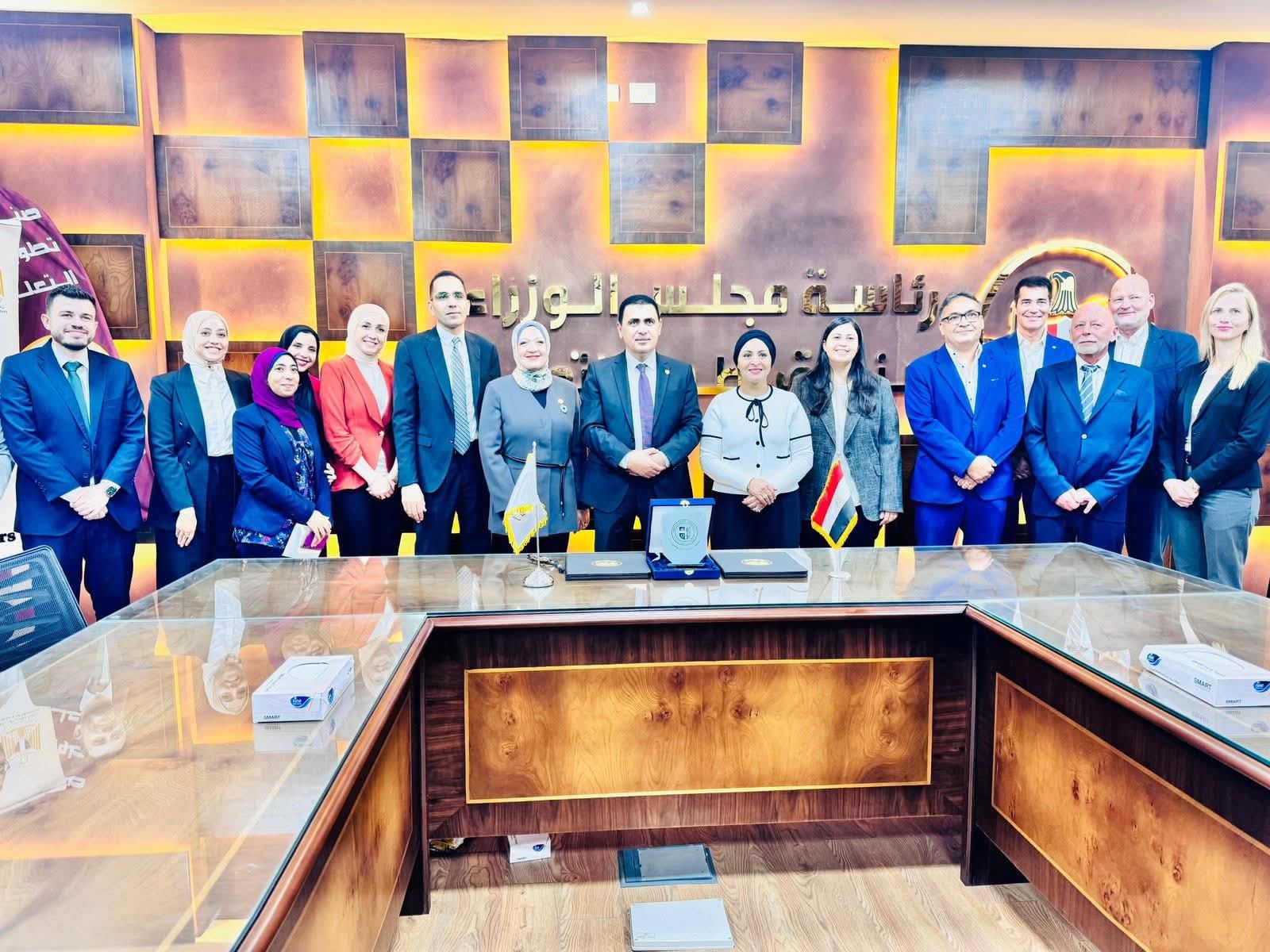

In a bold step toward international workforce integration, Egypt’s Education Development Fund (EDF), affiliated with the Cabinet, has announced a comprehensive partnership with Saxony University- Egypt to launch a pioneering training program aimed at preparing Egyptian graduates for skilled employment in Germany.
The initiative, unveiled at EDF headquarters in Cairo, marks a significant chapter in Egypt’s ongoing education reform agenda and reflects the government’s deepening efforts to align the country’s technical and vocational education with international labor market demands—most notably those of Germany, Europe’s economic powerhouse.

A Strategic Shift in Egypt’s Education-to-Employment Model
The new program will provide advanced vocational training, industry-recognized certifications, and language instruction tailored to the requirements of the German job market. It is the result of a joint effort between Saxony University Egypt—a collaborative venture by CIRA Education and Al Ahly Capital Holding—and the Education Development Fund.
“This agreement represents a strategic shift in how we empower Egyptian youth for the global economy,” said Dr. Rasha Saad Sharaf, Secretary-General of the EDF. “We are not only equipping graduates with technical skills, but also building a sustainable model that opens international pathways for our workforce.”
Sharaf emphasized that the initiative is directly aligned with Egypt’s Vision 2030 and the state’s broader strategy to position the country as a global hub for highly skilled labor. The program also includes logistical, financial, and institutional support for successful candidates, including assistance with travel and coordination with relevant German authorities.
Aligning with Germany’s Labor Market Needs
Germany, facing acute labor shortages in various technical sectors, has increasingly turned to international cooperation to fill the gap. This program aims to bridge that demand with Egypt’s large pool of young graduates, particularly in areas such as healthcare, engineering, mechatronics, and skilled trades.
Dr. Mohamed Abdel Rahman, President of Saxony University Egypt, called the agreement a “strategic leap” for vocational and technical education in the region. “We are integrating rigorous academic standards with hands-on training and international certification. This ensures our graduates are not only competent—but competitive by global benchmarks, especially the German model, which remains a gold standard.”
Industry-Driven Training with International Certification
According to Dr. Khaled Taha, Executive Vice President of Saxony International School for the Middle East, the university will take charge of issuing certifications, setting German-language proficiency requirements, and designing curricula based on real-time labor market data from Germany.
“We are maintaining direct communication with German employers and industry representatives to ensure that our training remains relevant,” Taha said. “Graduates from this program will not only have theoretical knowledge but also the practical acumen to succeed in competitive environments abroad.”
A Gateway to Future Collaboration
The initiative also aims to establish a national database of skilled Egyptian graduates, creating a more targeted approach to workforce development and enabling future academic exchange and tech-transfer agreements between Egypt and Germany.
The partnership sets the stage for broader international cooperation in dual education systems, offering long-term potential for Egyptian institutions to adopt and co-develop global standards in vocational training.
National Impact and International Outlook
The agreement is being hailed as a transformative milestone in Egypt’s strategy to enhance employability and economic mobility for its youth. It also underscores the state’s commitment to redefining technical education as a cornerstone of national development, with a global outlook.
“This is more than a training program,” Sharaf noted. “It is a bridge—between education and employment, between Egypt and Europe, and between potential and opportunity.”
The program is expected to begin accepting applications in late 2025, with pilot cohorts set to begin training in early 2026.