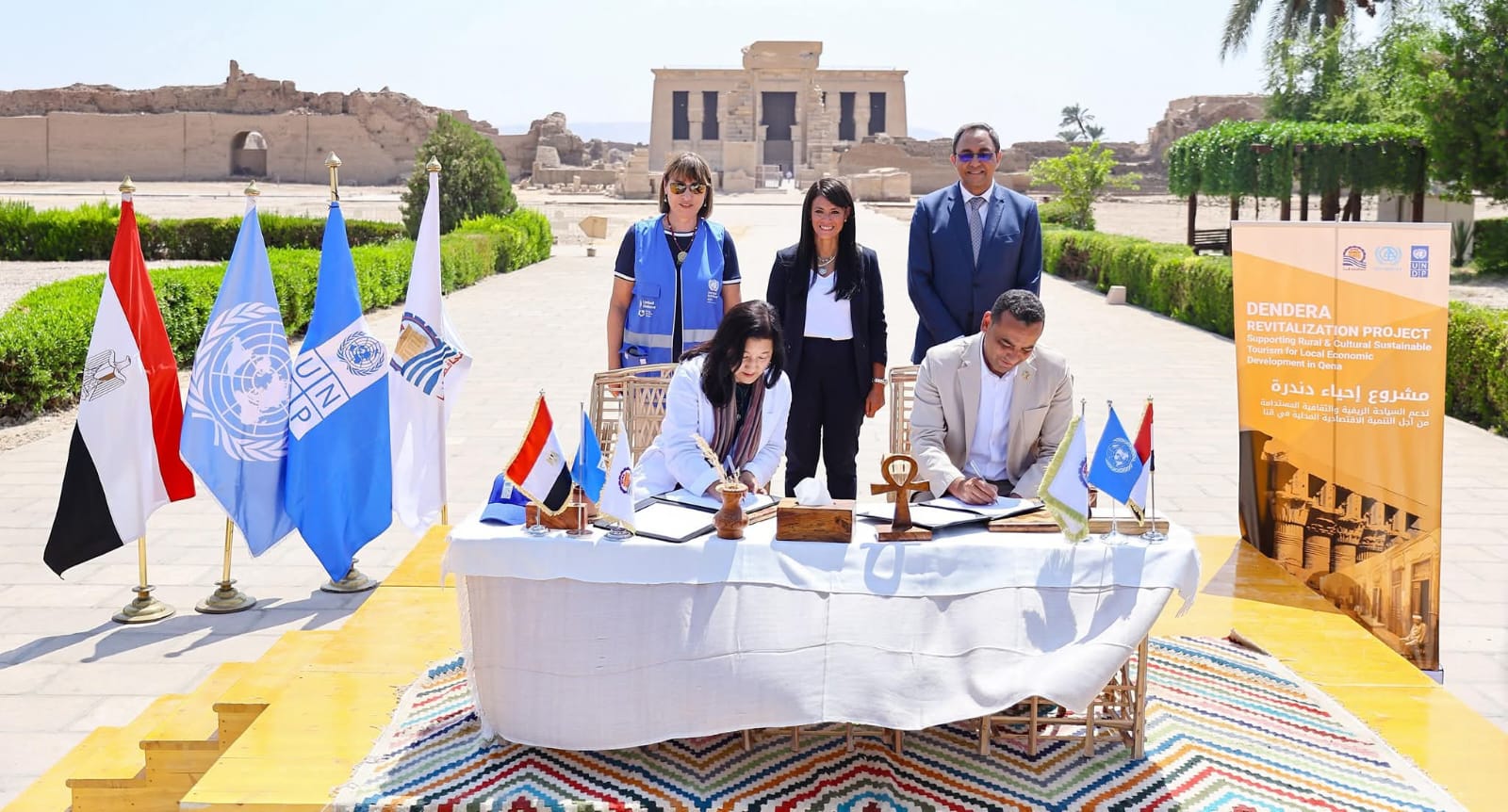

Integrating cultural heritage with local economic development, Egypt has signed a new partnership agreement with the United Nations to promote sustainable rural and cultural tourism in the historic city of Qena. The initiative centers around Dendera, home to one of Egypt’s most important ancient temple complexes.
The agreement was signed in the presence of Dr. Rania Al-Mashat, Egypt’s Minister of Planning, Economic Development, and International Cooperation; Dr. Khaled Abdel Halim, Governor of Qena; and Elena Panova, the United Nations Resident Coordinator in Egypt.

The partnership, formalized between the United Nations Human Settlements Programme (UN-Habitat) and the United Nations Development Programme (UNDP), aims to create an inclusive, sustainable rural tourism model that links cultural heritage to local economic opportunity.
Reviving Dendera: Culture, Community, and Sustainable Growth
Anchored in the “Reviving Dendera” initiative, the project seeks to leverage the globally renowned Dendera Temple Complex and its surrounding agricultural landscape to establish a living tourism economy rooted in local participation, economic inclusion, and cultural preservation.
The project will unfold in two key phases:
- Planning Phase:
- Development of an Integrated Revitalization Plan
- Strategic framework for tourism competitiveness, urban development, and local economic growth
- Creation of a distinct tourism identity for Dendera
- Implementation Phase:
- Restoration of select cultural assets
- Upgrades to visitor infrastructure and services
- Introduction of high-quality, sustainable tourism experiences
- Local capacity-building, especially for youth and women
The technical execution will be carried out in close collaboration with the Qena Governorate, with support from development consultancy firm Takween for Integrated Community Development.
Dr. Rania Al-Mashat: Dendera Project is a Model for Regional Development
“Qena possesses tremendous potential for rural and cultural tourism, particularly with landmarks like the Dendera Temple,” said Dr. Al-Mashat. “Through national efforts such as the Presidential ‘Decent Life’ Initiative, we’ve already improved services for over 1.5 million citizens in Qena, creating real momentum for further investment.”
She emphasized that the government is focused on localizing sustainable development, increasing public investment, and enhancing infrastructure to attract both domestic and international private sector partners.
Local Tourism as a National Strategy
The new tourism model aligns with Egypt’s broader goals to decentralize development and promote regional tourism.
Qena Governor Dr. Khaled Abdel Halim highlighted the strategy to combine rural tourism with cultural tourism, making Dendera a distinctive stop on Egypt’s tourism map. The tourism experiences will feature:
- Rural farm visits and eco-tourism
- Traditional crafts and artisan demonstrations
- Folklore performances (mizmar, tahteeb, and traditional horse shows)
- Local cuisine and agricultural experiences
“The project supports our vision to raise living standards, create jobs, and make Qena an engine of economic growth,” Abdel Halim noted.
United Nations: A Multi-Agency Model for Sustainable Tourism
UN Resident Coordinator Elena Panova celebrated the collaboration between two major UN agencies as a testament to multilateral partnerships’ power in achieving tangible, localized development outcomes.
“As we mark 80 years of the United Nations, this agreement showcases how inter-agency collaboration can drive real progress in places like Qena,” Panova said.
Ahmed Rizk, UN-Habitat Director in Egypt, called the agreement “a milestone in connecting cultural heritage with inclusive economic growth,” adding that it would “build resilient rural-urban linkages and empower local communities.”
UNDP Resident Representative Chitose Noguchi reinforced this view, describing rural tourism as “a direct lever for local development, enabling communities to benefit from preserving their environment and heritage.”
“This project will create new income streams, boost small businesses, and empower youth and women,” Noguchi said. “It’s an adaptable model for other regions across Egypt.”