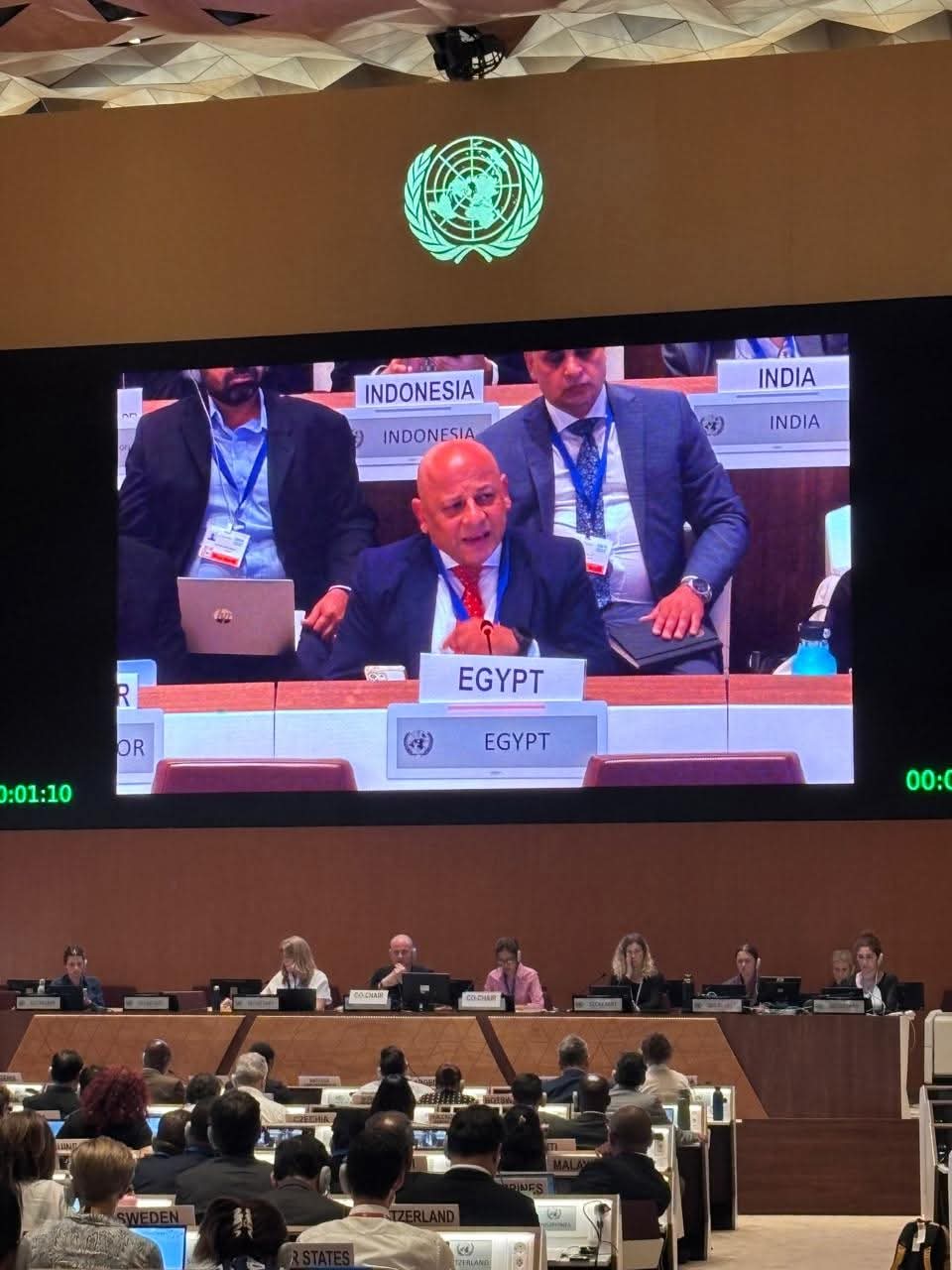

Egypt’s Acting Minister of Environment and Minister of Local Development, Dr. Manal Awad, has emphasized the pressing need for a legally binding international agreement to combat plastic pollution, citing its alarming impacts on public health, biodiversity, and global ecological balance. The remarks follow Egypt’s active participation in the latest round of negotiations for a global plastics treaty, held in Geneva from August 5 to 15.
The second part of the fifth session of the Intergovernmental Negotiating Committee (INC-5.2), convened under the auspices of the United Nations, brought together over 2,600 delegates from 183 member states and 400 observer organizations. These included environmental NGOs, waste pickers’ unions, youth representatives, and industry stakeholders—all unified by the urgent mission to draft an international, legally binding instrument to end plastic pollution.

Dr. Awad, speaking on behalf of the Egyptian government, reiterated the critical importance of forging consensus around a comprehensive global framework. “Plastic pollution poses an escalating threat to ecosystems and public health across the globe,” she stated. “It endangers countless species and undermines the delicate environmental balance essential to sustaining life on Earth.”
The Egyptian delegation, led by Dr. Ali Abu Senna, CEO of the Egyptian Environmental Affairs Agency, included representatives from the Ministries of Foreign Affairs, Petroleum and Mineral Resources, and the Federation of Egyptian Industries. The latter was represented by the Chamber of Chemical Industries and the Environmental Compliance Office, underlining Egypt’s whole-of-government and cross-sectoral approach to the negotiations.
Throughout the Geneva talks, the Egyptian delegation played a proactive role in advancing national priorities across all working groups. Key topics on the table included sustainable plastic production, raw material sourcing for plastic products, and financing mechanisms to support the implementation of the future treaty.
Despite the intensity of negotiations, the INC-5.2 session concluded without finalizing a treaty text. However, delegates agreed to reconvene for further negotiations, with a final round expected to determine the contours of the historic agreement. The timeline for this next round will be announced in the coming months.
On the sidelines of the formal proceedings, Dr. Abu Senna conducted a series of bilateral meetings with representatives from Germany, Norway, the United States, Bangladesh, and the United Kingdom. These diplomatic exchanges sought to build consensus and explore shared priorities on the path toward a binding agreement. Egypt also participated in regional coordination meetings with the African Group, the Arab Group, and the “Like-Minded” group of countries, ensuring alignment on key procedural and substantive issues.
Dr. Awad emphasized the broader significance of achieving a consensus text, noting the rapid acceleration of plastic pollution and the corresponding need for an urgent and unified global response. “The environmental crisis we face requires solutions that are both collective and swift,” she said. “The responsibility to act decisively lies with us all.”
The Geneva round marks a critical milestone in the international community’s efforts to curb the scourge of plastic pollution. As nations inch closer to finalizing a global accord, Egypt’s assertive engagement reflects its growing leadership role on issues of environmental sustainability and international cooperation.