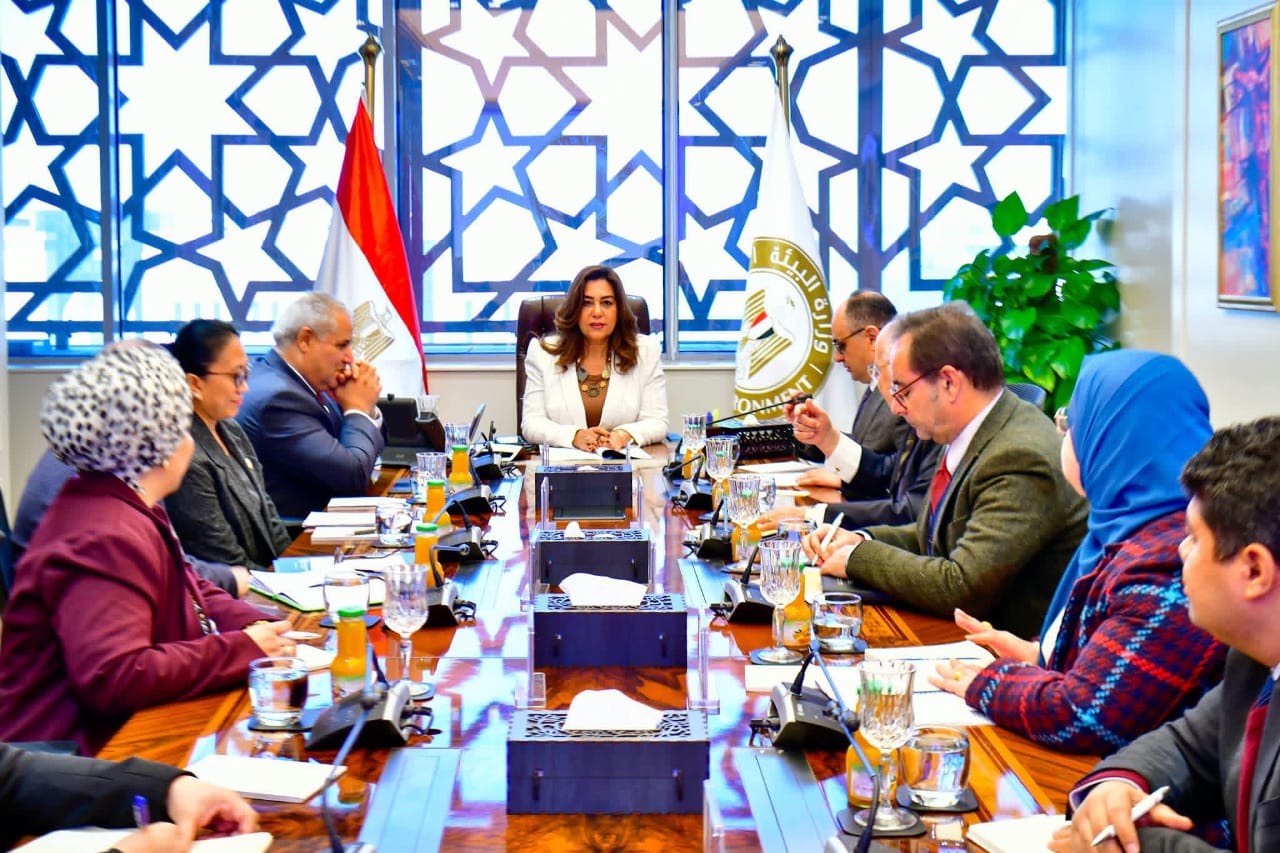

Egypt’s Minister of Local Development and Acting Minister of Environment, Dr. Manal Awad, held high-level talks with senior officials from the UN Food and Agriculture Organization (FAO) to expand joint cooperation on environmental projects with strong social and economic impact, as the country accelerates efforts to adapt to climate change and strengthen sustainable development.
The meeting brought together Dr. Abdel Hakim Elwaer, FAO Assistant Director-General and Regional Representative for the Near East and North Africa, Dr. Jacqueline Benatt, Acting FAO Representative in Egypt, and senior FAO experts, alongside top Egyptian environmental and climate officials.

Strengthening Climate Adaptation at the Local Level
Dr. Awad emphasized the depth of the long-standing partnership between Egypt’s Ministry of Environment and FAO, noting that joint projects have already delivered tangible environmental and social benefits. These include the sustainable management of agricultural ecosystems in the Kharga Oasis in New Valley Governorate, support for the Farafra Oasis, and collaboration with other ministries on modern irrigation systems, climate-resilient crops, and improved agricultural practices in Upper Egypt.
She highlighted ongoing cooperation aimed at enhancing the capacity of Egyptian governorates to adapt to climate change. Among the flagship initiatives is a national program—supported by the Green Climate Fund (GCF) and implemented with FAO, UN-Habitat, and the International Union for Conservation of Nature (IUCN)—to rehabilitate ecosystems and strengthen climate resilience in Alexandria, the Nile Delta, Damietta, and Port Said.
“These projects are not only about protecting ecosystems, but also about improving livelihoods and delivering a dignified life for local communities,” Dr. Awad said.
Sustainable Agriculture, Fisheries, and Regional Initiatives
The discussions also reviewed Egypt’s participation in regional initiatives, including the Red Sea Large Marine Ecosystem fisheries project (RedSeaFish), funded by the Global Environment Facility, and the SCALA program, which supports countries in integrating climate ambition into land use and agriculture policies.
Dr. Awad praised FAO’s role in advancing the FAST (Food and Agriculture for Sustainable Transformation) initiative, launched during COP27 in Sharm El-Sheikh. The initiative, now joined by 40 countries, aims to mobilize climate finance and accelerate sustainable food systems worldwide.
Expanding Biogas and Organic Fertilizer Production
A key focus of the talks was expanding the production of organic fertilizer from large-scale biogas units, particularly in major livestock farms across Egypt’s governorates. Dr. Awad said the initiative could enhance the competitiveness of Egyptian agricultural exports by aligning them with new European standards, including CEBAM requirements.
Building on Egypt’s existing experience with small and medium biogas units—such as those used in slaughterhouses—the ministry plans to work with FAO on a comprehensive study to identify economically viable livestock farms capable of producing significant quantities of organic fertilizer.
Addressing Stray Dogs with a Balanced Approach
Dr. Awad also called for joint technical support from FAO to address the growing challenge of stray dogs in Egypt, stressing the need for solutions that maintain ecological balance while ensuring public safety. She directed the preparation of a joint study to develop humane, effective management approaches, including vaccination strategies.
Mobilizing Climate Finance and Supporting National Strategies
The minister underscored Egypt’s interest in leveraging FAO’s expertise to access new climate finance mechanisms, such as the Loss and Damage Fund and the new Mitigation Fund. She noted that such funding could support urgent national priorities, including protecting the North Coast from sea-level rise and improving livelihoods in vulnerable communities.
She reaffirmed Egypt’s commitment to implementing its National Climate Change Strategy, Nationally Determined Contributions (NDCs), and National Biodiversity Strategy, with a focus on climate-smart agriculture, renewable energy for irrigation, and sustainable food value chains.
FAO Reaffirms Strategic Partnership with Egypt
For his part, Elwaer emphasized FAO’s commitment to supporting Egypt’s national priorities in food security, climate resilience, and ecosystem restoration. He praised Egypt’s leadership role in the region and described the partnership as “strategic and historic.”
FAO officials also highlighted ongoing projects in climate-smart agriculture, livestock development, and Red Sea fisheries, while stressing the importance of empowering rural women and youth as key drivers of sustainable and resilient food systems.
As Egypt deepens its cooperation with FAO, officials on both sides said the partnership will play a central role in aligning environmental protection, climate action, and social development—positioning the country as a regional leader in sustainable transformation.