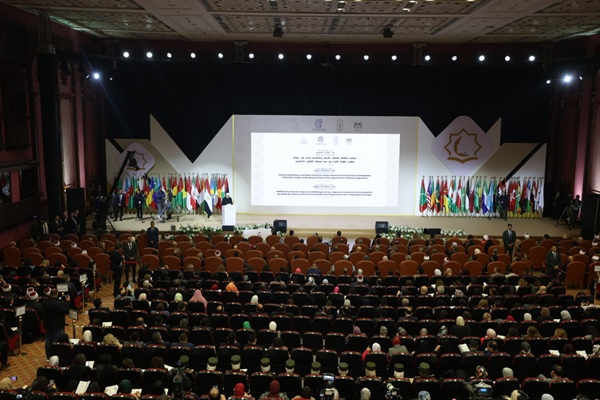

An international conference titled “Investing Religious and Media Discourse and Its Impact on Protecting and Promoting Women’s Rights in OIC Member States” took place on February 1–2, 2026, at the Al-Azhar Conference Hall in Nasr City, Cairo. The event was organized by Al-Azhar, the National Council for Women, and the Women Development Organization, under the patronage of President Abdel Fattah El-Sisi, with participation from representatives of all 57 member states of the Organization of Islamic Cooperation (OIC).
High-Level Participation and Agenda
The two-day forum convened senior religious figures, government officials, and gender experts to examine how religious interpretation and media communication can support women’s rights. Among the attendees were Dr. Ahmed El-Tayeb, Grand Imam of Al-Azhar; Dr. Mostafa Madbouly, Egyptian Prime Minister; and Amal Ammar, President of the National Council for Women. Delegates explored a broad agenda including correcting cultural misconceptions about women, economic participation, political leadership, and digital safety.

Hala El-Said on National Experience
In remarks to the press during the conference, Hala El-Said, Egypt’s Presidential Advisor for Economic Development, highlighted Egypt’s National Strategy for the Empowerment of Women 2030, noting its comprehensive approach to strengthening women’s roles in economic, social, and political spheres. El-Said described the conference as a platform for exchanging best practices with OIC partner states, reinforcing commitments to equality and justice in both policy and discourse.
Marianne Amir Azer and Cybersecurity Concerns
A distinct focus of the conference was digital safety and cybersecurity as part of protecting women’s rights. Marianne Azer, a member of Egypt’s National Council for Women and expert in scientific research, addressed the emerging threat of online violence against women, including harassment and harmful digital practices. Her contribution underscored how online platforms can shape public perception and, without safeguards, expose women to rights violations — pointing to the need for stronger cyber protection frameworks within OIC countries.
Azer pointed out that “73 % of women around the world are exposed to digital harassment and online pursuit through cybersecurity threats,” noting that electronic blackmail, defamation, the sharing of inappropriate images and personal information, and online hate speech represent serious risks to women’s rights and dignity. She advocated for integrated mechanisms for prevention, protection, and digital literacy to ensure women can use digital spaces safely
Sessions and State Perspectives
The program included multiple thematic sessions:
- Day One: The role of religious and media discourse in correcting misconceptions about women and combatting extremist narratives, as well as women’s economic rights, workforce participation, and entrepreneurship best practices — with examples cited from countries such as Azerbaijan reporting that women constitute over 50 % of entrepreneurs in certain sectors.
- Day Two: Discussions centered on protecting women from violence, including cultural practices and digital threats, and panels on political participation and leadership.
The two-day event examined how religious messaging and media narratives can support women’s rights.Reflecting on cyber incidents, the inclusion of a dedicated session on protection from cyber violence reflects a growing acknowledgement among participating states that digital harms — from online harassment to image-based abuse — pose real risks to women’s civic engagement and safety.
Cybersecurity within Women’s Rights Frameworks
The conference reflected a shift among policymakers toward integrating cybersecurity within women’s rights frameworks, alongside traditional topics like economic inclusion and cultural discourse. Organizers indicated that outcomes and discussions would inform future collaborative work among OIC member states, though no formal communique had been released at the time of reporting.