
An Egyptian archaeological mission has uncovered the remains of a fully integrated monastic residential complex dating back to the Byzantine era in Upper Egypt, offering rare insight into early Christian monastic life along the Nile.
The discovery was made at the archaeological site of Al-Qariya bi al-Duwair in the Tama district of Sohag Governorate, during ongoing excavations led by the Supreme Council of Antiquities, according to a statement released by Egypt’s Ministry of Tourism and Antiquities.

A Window Into Byzantine Monastic Life
Egypt’s Minister of Tourism and Antiquities, Sherif Fathy, said the find underscores the depth and diversity of Egypt’s cultural heritage across historical periods. He emphasized that such discoveries strengthen the country’s cultural tourism sector and help spotlight lesser-known archaeological destinations, particularly in Upper Egypt.
“This type of discovery enhances Egypt’s position as a global destination for religious and cultural heritage tourism,” the minister said, noting its appeal to scholars and visitors interested in the history of religions and civilizations.
Structured Community for Monks
According to Dr. Mohamed Ismail Khaled, Secretary-General of the Supreme Council of Antiquities, the excavation results reveal a well-organized settlement pattern that strongly suggests the site functioned as a cohesive monastic community during the Byzantine period.
The uncovered structures include rectangular mudbrick buildings oriented west to east, with dimensions ranging from approximately 8 by 7 meters to 14 by 8 meters. Many of the buildings contain elongated halls, some featuring apses or niches used for prayer, along with small vaulted rooms believed to have served as private cells for monks’ worship and living quarters.
Walls preserved layers of plaster and include wall niches and recesses, while floors were coated with mortar. Several buildings also feature southern courtyards with entrances, as well as small circular structures thought to have been communal dining tables used by monks.
Church and Industrial Features Identified
Excavations also revealed basins constructed from red brick and limestone, coated with red plaster. Archaeologists believe these installations were used for water storage or small-scale industrial activities connected to the monastery’s daily life.
One of the most significant finds is a large mudbrick building measuring roughly 14 by 10 meters, identified as the main church serving the monastic complex. The church consists of three architectural sections: the nave, choir, and sanctuary. Evidence of mudbrick pillars suggests the nave was once topped by a central dome, while the sanctuary features a semi-circular apse flanked by two side chambers.
Artifacts With Coptic Inscriptions
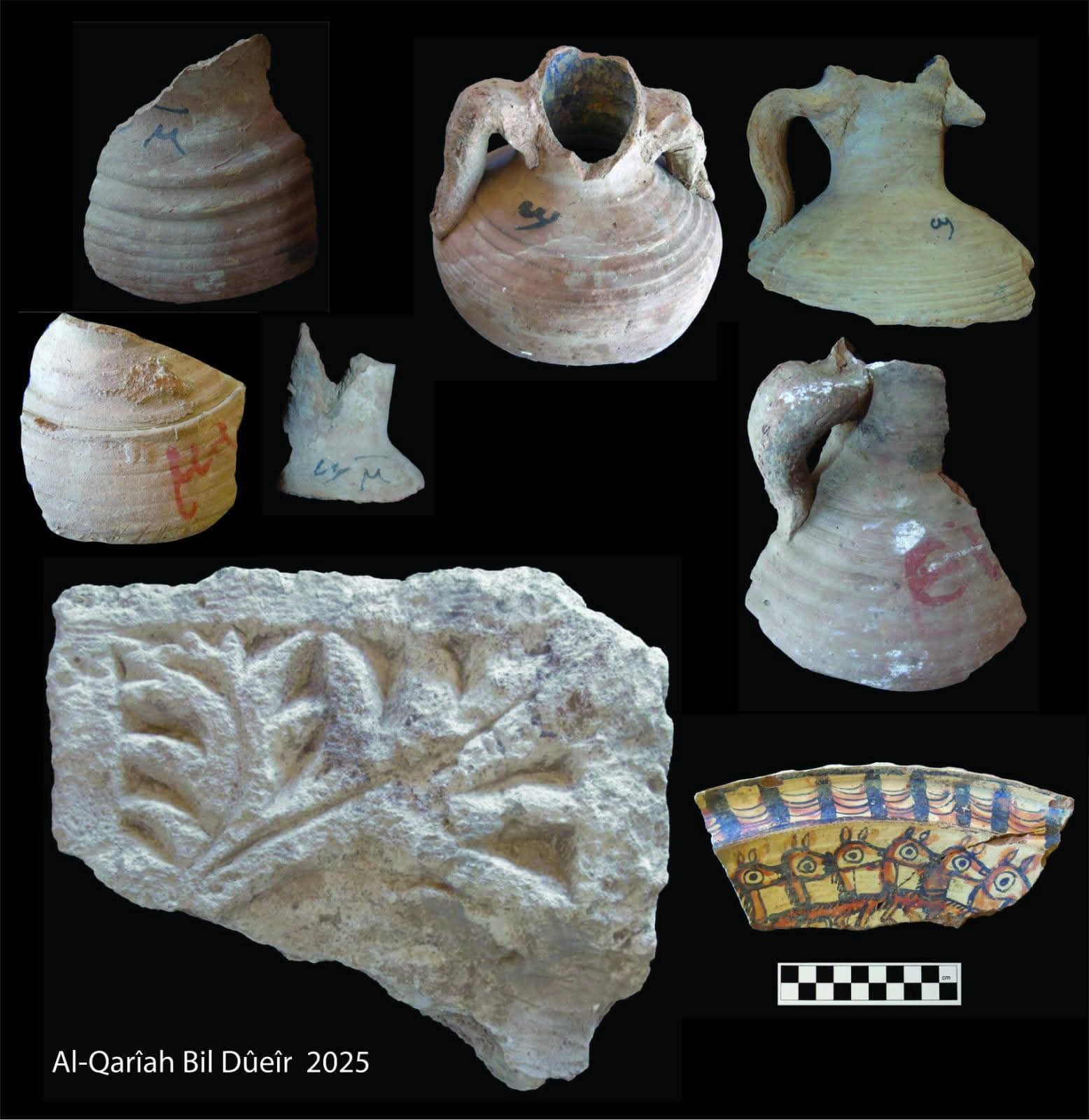
The mission also uncovered a variety of artifacts, including storage amphorae, some bearing inscriptions that may represent letters, numbers, or personal names. Additional finds include ostraca inscribed in the Coptic language, everyday domestic tools, stone fragments from architectural elements, and limestone panel pieces engraved with Coptic script.
According to Walid El-Sayed, head of the archaeological mission, these artifacts provide valuable textual and material evidence for understanding religious practices, administration, and daily life within Byzantine monastic communities in Upper Egypt.
Expanding Egypt’s Archaeological Map
The Sohag discovery adds to a growing body of evidence highlighting Upper Egypt’s role as a major center of early Christian monasticism. Archaeologists say continued excavations at the site are likely to yield further insights into how monks lived, worshipped, and organized their communities more than a millennium ago.
As Egypt continues to invest in archaeological research beyond traditional tourist hubs, discoveries like this are reshaping both scholarly understanding and the future of cultural tourism in the region.