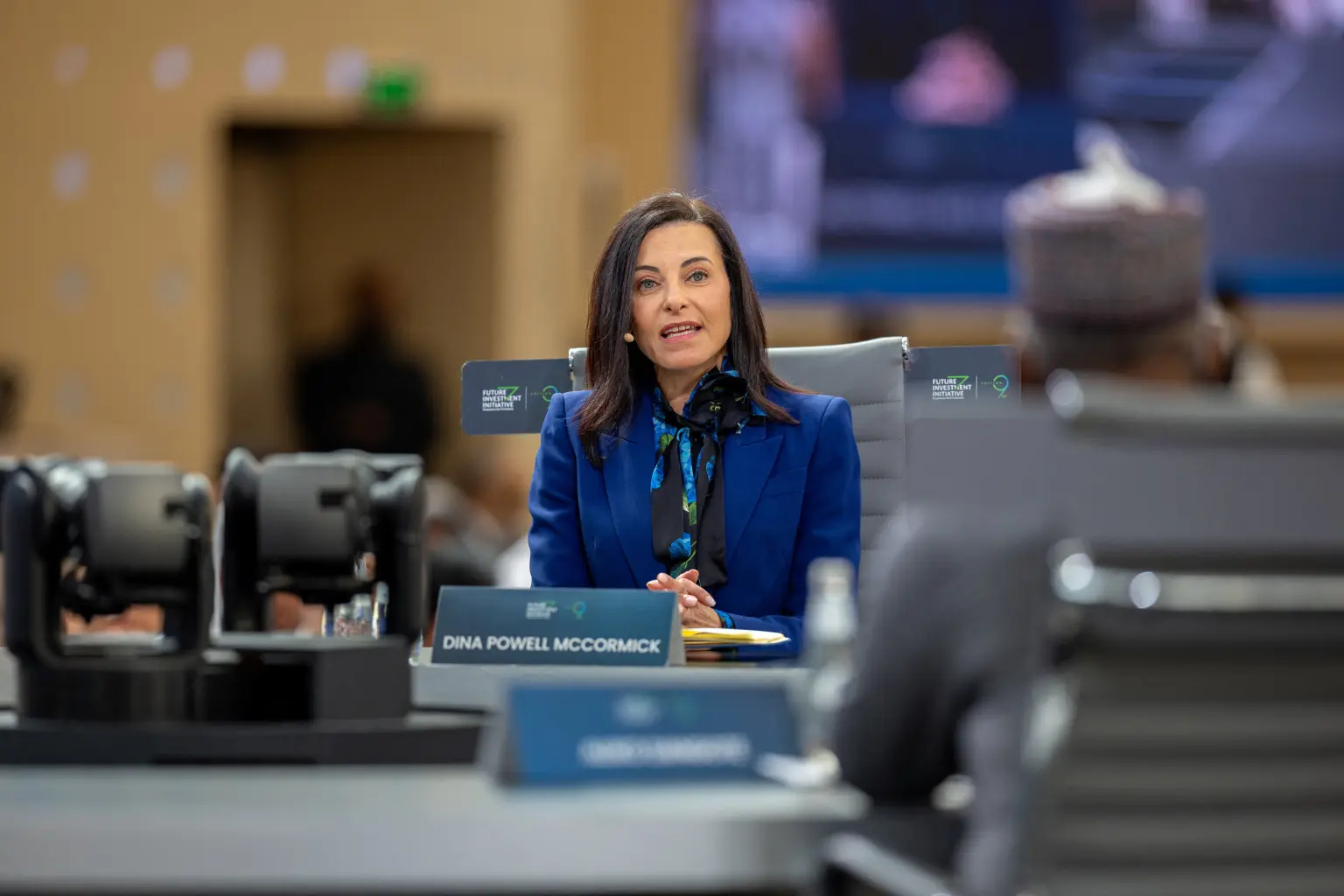

Meta has recruited one of Wall Street’s most influential power brokers to guide its next phase of growth, tapping veteran dealmaker and former Goldman Sachs executive Dina Powell McCormick as the company’s first-ever president and vice chair.

The move signals a strategic shift for Meta as it looks beyond internal spending to global partnerships and outside capital to fund an ambitious $600 billion infrastructure buildout tied largely to artificial intelligence over the next decade.
Powell McCormick brings decades of experience cultivating relationships with sovereign wealth funds, global investors, and political leaders—connections investors say Meta increasingly needs as the AI arms race intensifies.
A strategic hire for a capital-intensive AI future
Meta founder and CEO Mark Zuckerberg praised the appointment, highlighting Powell McCormick’s rare blend of financial and geopolitical expertise.
Meta has already spent billions to expand its AI capabilities, including a nearly $15 billion deal with Scale AI founder Alexandr Wang for data labeling and other services. While those investments underscore Meta’s ambitions, shareholders have increasingly pushed the company to emulate rivals such as Nvidia, OpenAI, and xAI by tapping strategic partners and sovereign capital, particularly in the Middle East.
Over the past year, the region has emerged as a critical hub for AI investment, offering massive pools of capital, abundant energy resources, and government-backed ambitions to dominate advanced computing. Powell McCormick’s résumé is closely aligned with that landscape.
From Goldman Sachs to the Meta C-suite
Powell McCormick spent decades at Goldman Sachs, where she rose to partner and ran the firm’s sovereign wealth fund business. She also helped launch Goldman’s 10,000 Women and 10,000 Small Businesses initiatives, programs focused on expanding access to capital and business education for entrepreneurs worldwide.
Most recently, she served as vice chair, president, and head of global client services at BDT & MSD Partners, a merchant bank known for advising billionaire founders and family offices. She will step down from that role but remain on the firm’s advisory board.
Her relationship with Meta is not new. Powell McCormick joined the company’s board in April 2025, alongside figures such as Stripe co-founder Patrick Collison, Andreessen Horowitz co-founder Marc Andreessen, and UFC president Dana White. She exited the board last month ahead of assuming her executive role.
Deep ties to Washington and beyond
Born in Egypt, Powell McCormick immigrated to the United States at age six, speaking no English. She later served in two presidential administrations—first under George W. Bush, and then as Deputy National Security Advisor during President Donald Trump’s first term, where she worked on initiatives that helped lay the groundwork for the Abraham Accords.
Trump publicly congratulated Powell McCormick on her new role, calling the hire “a great choice by Mark Z!!!” and praising her service “with strength and distinction.”
She is married to David McCormick, the former CEO of Bridgewater Associates and a Republican senator from Pennsylvania, adding another layer to her already expansive political and financial network.
What it means for Meta
For Meta, the appointment marks a turning point. After years of funding growth largely through internal cash flow, the company appears poised to pursue global capital partnerships, particularly as AI infrastructure costs soar and competition for compute power and rare earth resources intensifies.
Investors welcomed the news as a sign that Meta is preparing to compete not just as a technology company, but as a global infrastructure builder—one that requires diplomacy, dealmaking, and access to the world’s deepest pools of capital.
With Dina Powell McCormick stepping into the newly created president role, Meta is betting that Wall Street savvy and geopolitical reach will be just as critical as engineering talent in determining who wins the AI race.